
Strategic Foundations for AI: Turning Process, Architecture, and Data into Institutional Advantage
Markham, Ph.D.(c), Interim President and Chief Executive Officer, Edge, led the highly attended breakout session, Strategic Foundations for AI: Turning Process, Architecture, and Data into Institutional Advantage. With institutions facing digital complexity, declining margins, and accelerated AI adoption, Markham underscores the importance of understanding AI not just as a technological shift but as a transformational moment. “History doesn’t repeat itself, but it sure does rhyme. I’m a big believer in that continuity throughout change, and I see what’s happening with AI today as rhyming with the advent of online learning. For the higher education ecosystem, the parallels with online learning are striking. You can see them in pedagogy—the operationalization of teaching and learning—in research, and across the administrative functions of the student lifecycle. Everything from recruitment to alumni and donor relations reflects this continuity.”
In his dissertation and PhD work, Markham examined AI through the lens of general purpose technologies and their historical patterns. “What I’m finding, both in current and seminal literature, is that AI clearly fits this model,” shares Markham. “The data shows AI is following what economists call the J-curve, a delayed but accelerating return on productivity and investment. The J-curve pattern shows that productivity initially dips following adoption before ultimately rising beyond the baseline. The early decline reflects the adjustment period, where institutions learn, restructure, and reengineer processes to align with the new technology. Every General Purpose Technology (GPT), including steam, electricity, and computing began with a dip, where the productivity lags reflect the time required to adapt people, process, and capital. GPTs have the ability to transform entire economies, not just single sectors. The power of AI lies in its generality and its ability to rewire knowledge work itself.”
Organizational Adaptation in the Age of AI
Challenging the notion that artificial intelligence can be a plug-and-play solution, Markham argues that its successful integration depends not on the technology itself, but on the human and organizational systems surrounding AI. “If you think about the long history of software and systems development, methodologies such as the Systems Development Life Cycle (SDLC) were designed precisely to prevent technology from becoming “shelfware,” or tools that are purchased but never meaningfully used,” explains Markham. In enterprise environments, failures often occur when organizations neglect time-proven frameworks like SDLC, which is a methodology grounded in information systems and business science.
“Technologies are not plug-and-play. Instead, they rely on rigorous requirements gathering, elicitation, and business analysis. These activities are fundamentally economic because they require eliciting meaning and value directly from the human actors within an organization. This way you gain an understanding of their microeconomic wants and needs, and can translate those insights into technical and business taxonomies that shape system design and project management.”
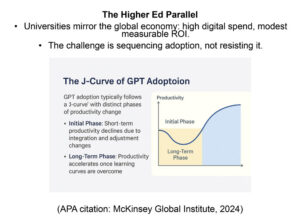 This same logic applies to artificial intelligence, says Markham. “Despite its popular portrayal as a turnkey solution, AI is a general-purpose technology that demands organizational adaptation. While consumer-facing tools like ChatGPT, Gemini, or Claude may seem plug-and-play to individuals, institutional systems, such as research computing clusters, administrative databases, or learning management systems, require deliberate planning, integration, and long-term commitment. AI, therefore, has no intrinsic value or meaning apart from the people and processes that give it purpose. Like previous technological revolutions, it takes time for the real value of AI to emerge, but once it does, the impact will be profound.”
With these insights in mind, Markham explains that a timely investment determines success. “Organizations must make the right complementary investments in workforce training, process redesign, and infrastructure to avoid getting stuck in the trough of the J-curve. Those that do so rise quickly to realize returns; and those that don’t either fail to achieve productivity gains or reach them too late to remain competitive. Leadership is virtue-based and management is function-based and many organizations forget that distinction. Good leaders know how to balance the virtue of patience with the virtue of urgency. They cultivate both within the culture they lead, whether corporate, academic, or administrative, so that their organizations can maintain a healthy balance between patience and timely action.”
“The data shows AI is following what economists call the J-curve, a delayed but accelerating return on productivity and investment. The J-curve pattern shows that productivity initially dips following adoption before ultimately rising beyond the baseline. The early decline reflects the adjustment period, where institutions learn, restructure, and reengineer processes to align with the new technology.”
– Christopher Markham Ph.D.
President and Chief Executive Officer,
Edge

The Five Vs of Data
By mapping how an institution operates across the student lifecycle (business process modeling) and ensuring technology truly aligns with mission (enterprise systems architecture), leaders establish the strategic bedrock on which AI can deliver impact. “In ten years, every college and university will have some form of AI-driven campus intelligence, just as business intelligence and predictive analytics defined the last twenty-five years,” says Markham. “As institutions move toward AI-driven campus intelligence, the foundation of that transformation lies in data architecture, with Hybrid Transactional Analytical Processing (HTAP) at the core of this shift. Imagine writing on a notepad with one hand while, at the exact same time, you’re analyzing what you’ve written with the other hand. Not before or after, but simultaneously. That’s what the HTAP data framework enables: the ability to create and analyze data in real time.”
Most institutions today operate under traditional data warehouse or data lake architectures that separate these processes. In contrast, an HTAP framework allows for real-time analytics to be performed on live transactional data, forming the backbone of an intelligent, adaptive campus environment. “To assess the maturity and governance of such an environment, we use five governance maturity metrics or the 5 Vs of data, where each represents a critical capability of a data-driven ecosystem,” explains Markham. “Managing the five Vs of data turns raw information into trustworthy intelligence that drives financial sustainability, operational resilience, and academic excellence.

Volume ➥ “Volume represents the scalability of data storage and the governance policies that support it,” says Markham. “This metric encompasses lifecycle management, cost control, and storage optimization, and ensures that the HTAP environment can handle large and growing data sets without performance collapse. Scalable storage is essential for maintaining stability as institutional data demands expand.”
Velocity ➥ Velocity measures the speed at which data moves through systems. “It’s about real-time streaming standards, low-latency pipelines, and continuous monitoring,” says Markham. “Within an HTAP environment, velocity ensures that analytical insights and transactional operations stay synchronized to the millisecond and keep the system dynamic, responsive, and continuously up to date.”
Variety ➥ Variety refers to integration and interoperability. “This metric reflects an institution’s ability to manage structured and unstructured data through standardized schemas, unified data catalogs, and accessible APIs,” explains Markham. “For an HTAP system, variety ensures that data from different sources—academic systems, administrative tools, sensors, or research databases—can be queried and analyzed seamlessly across multiple data types.”
Veracity ➥ “Veracity concerns trust and accuracy and is about having clear rules for data quality, validation routines, and master data management,” explains Markham. “In practical terms, veracity depends on strong governance: a clear understanding of who is responsible, accountable, consulted, and informed about each data asset. Within an AI-driven campus, veracity guarantees that live analytics rest on accurate, validated, and institutionally trusted data.”
Value ➥ “Finally, value represents the strategic payoff of data governance,” says Markham. “You define KPIs, stewardship roles, and feedback loops that connect data outputs to real institutional outcomes. In an HTAP framework, value ensures that insights generated by the system align with measurable goals and priorities that leadership can recognize and act upon.”
Human-Centered AI Adoption
In an era when much of the conversation around artificial intelligence is dominated by anxiety, disruption, and uncertainty, Markham’s EdgeCon presentation introduced a more optimistic lens. “Think about where culture and industry would be without general-purpose technologies like the locomotive, the automobile, electricity, mainframe computing, the personal desktop, the World Wide Web, and online learning,” said Markham. “Those seven innovations, spanning more than a century, have each transformed human life in fundamental ways.”
“We don’t even need complex terminology to understand their impact,” continues Markham. “Economists use the Human Development Index to measure quality of life, things like life expectancy, access to education, and standards of living. But in simpler terms, it’s about when societies gained running water, when homes got electricity, when people could move off farms and into cities, and when technology freed them from monotonous, isolated routines. These general-purpose technologies made that possible.”
“Institutions and governments that resisted such transformations did so at their own peril, or at the very least, delayed their own improvement in quality of life,” adds Markham. “I like running water. I like being able to power my home. I like not dying at 35 or 40. Those are direct benefits of embracing technological change. The same is true today. The Human Development Index isn’t just about health and education, but also human flourishing. AI has the potential to advance that index just as earlier technologies did. It can improve learning outcomes, increase access, and strengthen institutional resilience if we adopt it responsibly.”
“Despite its popular portrayal as a turnkey solution, AI is a general-purpose technology that demands organizational adaptation. While consumer-facing tools like ChatGPT, Gemini, or Claude may seem plug-and-play to individuals, institutional systems, such as research computing clusters, administrative databases, or learning management systems, require deliberate planning, integration, and long-term commitment. AI, therefore, has no intrinsic value or meaning apart from the people and processes that give it purpose. Like previous technological revolutions, it takes time for the real value of AI to emerge, but once it does, the impact will be profound.”
– Christopher Markham Ph.D.
President and Chief Executive Officer,
Edge
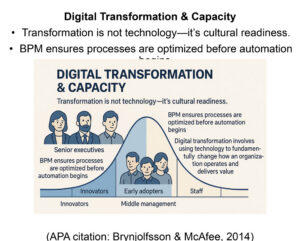 Markham says we’ve seen this pattern before. “Institutions that were slow to adopt the World Wide Web or online learning saw lower returns than those that moved early. But early adoption alone isn’t enough. Those that jumped in without making the right investments also failed to realize the full benefits. There’s a sweet spot, and it’s found in human-centered adoption. The Human Development Index applies not only to our personal lives but also to our public and professional lives. Technology matters most when it enhances human capability, dignity, and growth. That’s where AI can—and should—be a force for good.”
AI-Driven Campus Intelligence
Attendees of EdgeCon’s session Strategic Foundations for AI: Turning Process, Architecture, and Data into Institutional Advantage walked away with several actionable insights, including the importance of real-time readiness in institutional AI adoption. “Engaging with your own institutional business processes is critical,” Markham emphasized. “Do you have your current state business processes documented, leveraging business process modeling notation? Knowing exactly how your processes operate is essential because they interoperate with digital workflows, and there may be redundancies that need to be addressed. Data governance is also critical. Do you have a data dictionary? Is it updated regularly? If you understand your current state—your business processes, digital workflows, and data governance—you can model out future state processes that are evolved and improved. This includes your information systems architecture. You can think of it like a blueprint: what does the blueprint look like now, and what will it look like tomorrow for an AI-driven campus intelligence environment?”
Following these steps, Markham explained, allow institutions to respond in real time and ensure that AI adoption along the J-curve is methodical, maximizing the expected return on investment. “For CFOs and chief business officers, it’s easy to look at tangible assets, especially on a brick-and-mortar campus. Facilities are on your balance sheet and can be considered assets or liabilities. But data? That’s harder to recognize as an asset, but we must. Technology investments, largely intangible, drive roughly two-thirds to three-quarters of the U.S. GDP. By extension, an institution’s data is equally strategic.”
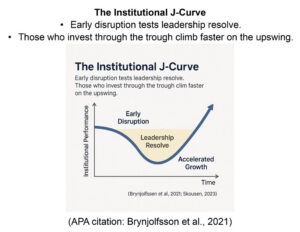 “We must remember that it’s not just student data or faculty data, or even data in your learning management system,” continues Markham. “There’s a wealth of data across the institution. AI allows senior executives to look straight down through the institution as if it were made of glass. But without treating data as a strategic asset, you lose that visibility and limit your ability to make the best decisions. Neglecting data stewardship is ultimately poor leadership. Leadership is virtue-based and value-based, while management is function-based, which is why we have the five functions of management in management science. Leadership starts with humility, which means recognizing that you don’t know everything. Just being in a leadership position, attending a conference, or reading a book on digital technologies doesn’t make you an expert. In fact, without humility, you might even be more dangerous.
You need the courage to empower your stakeholders to design the AI-driven campus intelligence environment. Stakeholders aren’t just a few selected change agents, they are everyone impacted by a project, product, or service. That inclusive definition ensures broad representation across the institution. An exclusive definition of stakeholders that focuses only on known change agents is a bad approach.
Instead, leaders should leverage their change agents to engage the entirety of the institution. This includes ensuring that the full cabinet or leadership team adopts an inclusive approach to AI initiatives. Once you have leadership buy-in, you can build a shared sense of urgency balanced with patience along the J-curve of adoption. Empower your change agents to plan and execute together with institutional stakeholders, ensuring the adoption is methodical and yields the expected return on investment.”
“The longer we embrace a doomsday mindset, the longer it will take to realize productivity gains and return on investment. There will be challenges ahead, otherwise, there wouldn’t be a dip in the J curve, but the dip is only a part of the journey. The curve extends far beyond its trough, representing the long-term gains and transformation that lie ahead. Leadership’s responsibility is to look beyond immediate obstacles, anticipate what’s coming, and guide the institution so that when we arrive, it is in the right way, with purpose, patience, and a clear vision for the future.”
– Christopher Markham Ph.D.
President and Chief Executive Officer,
Edge
Leveraging AI to Advance Institutional Goals
When it comes to AI adoption, success looks different at every institution. “Each organization is a unique entity, so success will look different depending on individual goals and resources,” explains Markham. “The goal is to find the approach that fits your context. Edge members like Princeton University, Rutgers University, Fairleigh Dickinson University, and Sussex Community College are each excelling in their own ways and leveraging AI to advance their institutional goals while respecting their unique environments.”
Looking ahead, Markham shares his enthusiasm for AI’s potential and the change this technology will bring to the academic community. “I’m excited to see the change AI will bring to academic, administrative, and research environments. I also foresee long-term return on investment and productivity gains, just like we saw with the Web, email, intranets, enterprise resource planning (ERP), customer relationship management (CRM) systems, and online learning platforms. These technologies brought latent productivity gains that we couldn’t have imagined working without. In the not-too-distant future, we’ll be saying the same thing about artificial intelligence.”
While recognizing the challenges of AI, Markham rejects fear-based thinking. “I do not subscribe to the doomsday notion that AI is going to displace faculty, staff, or students. Leaders should treat it like any other general-purpose technology and recognize that the time to start improving digital literacy and fluency was yesterday. The longer we embrace a doomsday mindset, the longer it will take to realize productivity gains and return on investment. There will be challenges ahead, otherwise, there wouldn’t be a dip in the J curve, but the dip is only a part of the journey. The curve extends far beyond its trough, representing the long-term gains and transformation that lie ahead. Leadership’s responsibility is to look beyond immediate obstacles, anticipate what’s coming, and guide the institution so that when we arrive, it is in the right way, with purpose, patience, and a clear vision for the future.”
Need help navigating the Productivity J-curve and unlocking the full potential of AI for your institution?
Your institution’s AI future starts with a strategic foundation. Through EdgeAI and Artificial Intelligence Readiness (AIR), we offer expert advisory and proven frameworks to assess AI readiness and deliver a 3-year roadmap for responsible, scalable innovation. Learn more at njedge.net/solutions/artificial-intelligence-readiness