EdgeAI Assessment
Find out where your institution really stands—and build a clear path forward.

Artificial Intelligence Readiness (AIR)
Most campuses don’t have an AI problem. They have a coordination problem: tools arrive faster than decision rights, data readiness, and human trust can keep up.
The Edge AIR (Artificial Intelligence Readiness) Assessment is designed to cut through that complexity. It’s not an audit and it’s not a test you can fail. It’s a structured process that produces a shared institutional truth — what’s real, what’s risky, and what’s next — so your leadership team can move forward with clarity and confidence.
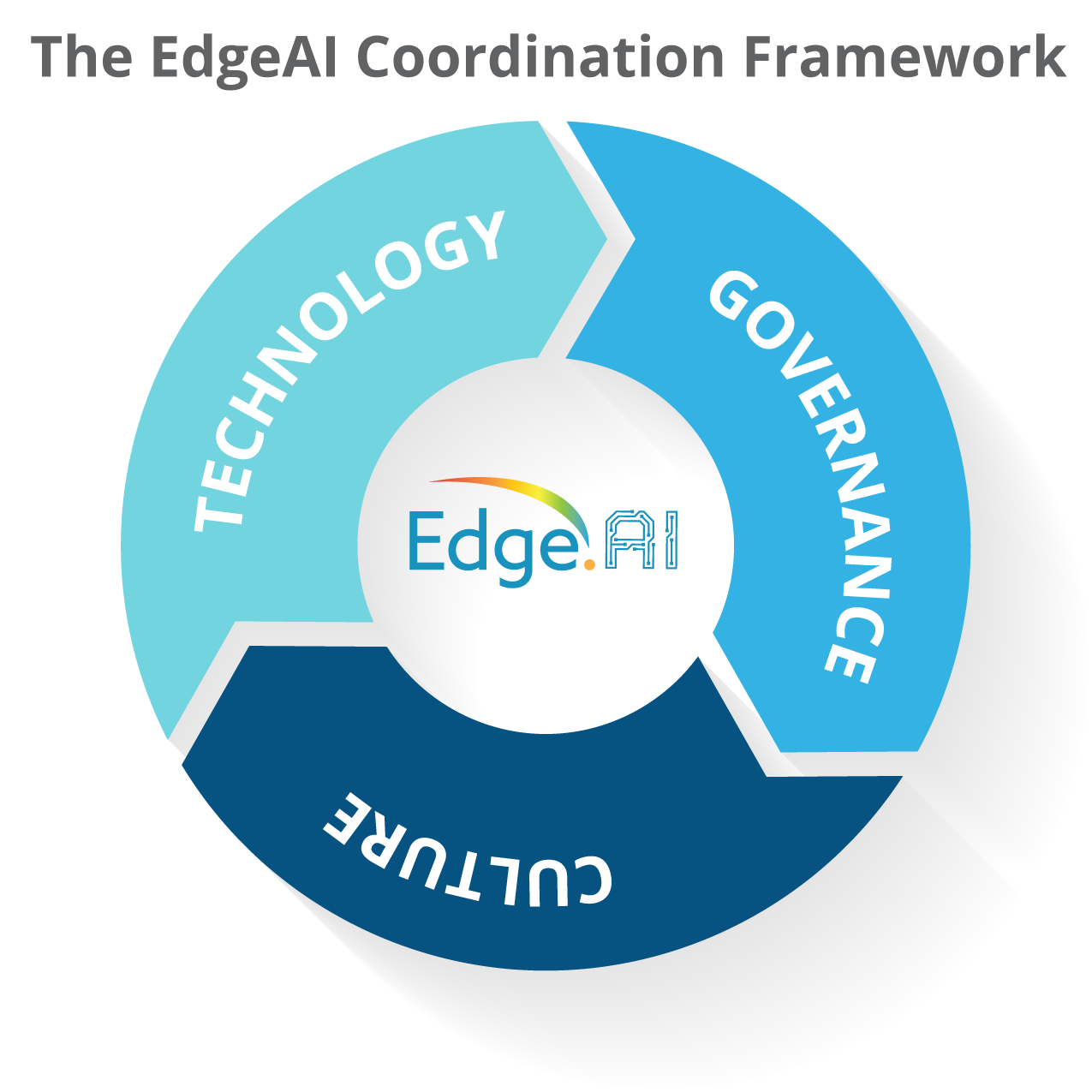
AIR is built around a simple premise: effective AI adoption requires three things working together, not just one.
Technology x Governance x Culture
TECHNOLOGY
Without governance, technology becomes “AI mushrooms” — a patchwork of disconnected pilots with no shared logic.
GOVERNANCE
Without culture, governance becomes compliance theater — policies that exist on paper but change nothing on the ground.
CULTURE
Without technology, culture becomes talk and fatigue — enthusiasm that never converts to action.
How the Assessment Works
AIR engages your institution through a structured sequence of conversations, diagnostics, and working sessions. The goal is not a report that sits on a shelf — it’s a set of usable artifacts your leadership team can act on immediately.
- Leadership Alignment
We start with structured conversations with your executive team — president, provost, CIO, CFO, and other key leaders — to understand your institutional priorities, constraints, and ambitions. This isn’t a requirements-gathering exercise; it’s a strategic alignment session.
- Institutional Diagnostic
Using Edge’s proven E360 methodology, we assess readiness across ten enterprise domains: strategy, governance, infrastructure, cybersecurity, data management, academic readiness, workforce capacity, finance, operations, and service management. Each domain is scored on a maturity scale and mapped to AI-specific readiness indicators.
- Stakeholder Engagement
Interviews, surveys, and facilitated sessions with academic, research, finance, and IT leaders. We listen broadly — because the coordination problem can’t be diagnosed from the IT office alone.
- Findings, Scorecard, and Roadmap
You receive an AIR Readiness Scorecard, a prioritized set of recommendations (what to start, stop, and continue), and a phased roadmap: a 12-month execution plan with a 24–60-month capability horizon. The roadmap includes sequencing logic and budget-level projections so you can plan, not just aspire.
What Your Institution Gets
A shared “readiness truth.” Not a vendor’s assessment of what you should buy — an honest, structured picture of where you stand across technology, governance, and culture, validated by your own stakeholders.
Prioritized recommendations. A clear set of start/stop/continue decisions so your leadership team isn’t trying to do everything at once.
A phased roadmap. 12-month execution plan plus a 24–60-month capability horizon with sequencing logic — realistic, budgeted, and tied to your mission.
Institutional alignment. A shared language and framework that lets the provost, the CIO, the CFO, and the faculty senate have a productive conversation about AI — instead of talking past each other.
An AI Readiness Scorecard. A quantitative baseline across ten enterprise domains, scored on a maturity scale, that you can track over time and use in board reporting.
Is AIR Right for Your Institution?
AIR is designed for institutions that recognize AI is an institutional-level strategic question — not just an IT project. It’s particularly valuable if:
- AI pilots are scattered across campus with no shared plan or evaluation framework
- Your leadership team knows you need an AI strategy but can’t agree on where to start
- You’re hearing from vendors faster than you can evaluate them
- Faculty, IT, legal, and procurement have different assumptions about what’s allowed
- Your board is asking about AI risk and you need a credible governance posture
Typical scenario: A mid-size institution has enthusiasm and scattered pilots across academics and student services, but no shared plan, no evaluation rhythm, and no governance framework. AIR converts that fragmented activity into a sequenced, mission-grounded roadmap — and gives every stakeholder a seat at the table.
Built on Proven Frameworks
AIR is powered by Edge’s E360 diagnostic methodology — a comprehensive enterprise assessment that has been refined through years of institutional engagements. The E360 model evaluates maturity across ten domains and cross-maps to established standards:
- TOGAF for enterprise architecture
- ITIL for IT service management
- NIST for cybersecurity readiness
- CMMI for organizational maturity
AIR extends E360 into the AI era by incorporating AI-specific readiness indicators — governance, ethics, algorithmic transparency, and data ecosystem evaluation — so the assessment addresses not just your technology posture but your institutional capacity to govern and sustain AI responsibly.
The assessment is delivered through Edge’s executive advisory team, including dedicated vCIO partnership, Business Process Modeling (BPM), and cybersecurity analysis (vCISO). These capabilities ensure that AIR isn’t just a diagnostic — it’s an advisory engagement with senior practitioners who understand higher education.
"AI in higher education should function as augmented intelligence, not as an efficiency tool. When institutions use AI to deepen learning, strengthen decision-making, and build collective institutional knowledge, AI reinforces the academic mission. When they use it merely to cut costs or automate existing practice, they risk making themselves replaceable."
– Robert Clougherty, Ph.D.
AI Lead, Edge

Ways to Engage
Virtual Briefing (Tier A): Start with a 60–90-minute leadership conversation to explore whether AIR is the right fit. No commitment required.
On-Campus Working Session (Tier B): A focused half-day or full-day session that produces a preliminary readiness picture and alignment on next steps.
Full AIR Engagement (Tier C): A multi-week engagement including the complete diagnostic, stakeholder engagement, scorecard, and phased roadmap. Typical duration: 6–10 weeks depending on institutional size and complexity.
Institutions can enter at any level. There’s no required sequence — we meet you where you are.
Ready to find out where your institution stands?
Schedule a confidential discovery conversation with our AI advisory team. We’ll help you determine whether AIR is the right starting point — and what a realistic engagement would look like for your campus.
Complementary Services & Solutions
If you’re seeking additional product inspiration or service solutions, we invite you to explore these complementary services: