
Everyone in One Room
What the print shop teaches about AI, IT, and the shift from enforcement to education
The license audit came back in April, and it was not what anyone had been looking for.
No rogue servers. No unapproved file sharing. Nothing that would have shown up on the risk register the CIO had presented to cabinet in the fall. What the audit found instead was eleven separate AI subscriptions spread across seven offices, nearly all of them priced just under the threshold that would have triggered procurement review, several paid on departmental cards and expensed as software. Advancement had one for donor research. The writing center had two, for different purposes, and could explain the difference. Institutional research had built something genuinely sophisticated on top of a third and had documentation for it—better documentation, as it turned out, than existed for several systems IT owned outright.
Nobody had broken a rule. There was no rule. And the people who had gone and solved their own problems were, by any ordinary measure of institutional health, the good ones: the staff who had noticed a bottleneck, found a tool, and gotten on with it.
The CIO's first instinct was consolidation. One vendor, one contract, one acceptable use policy, one approved pathway, and a short memo explaining that unapproved tools create exposure. It is a reasonable instinct. It is also, I want to argue, a scriptorium instinct—and it will fail for the same reason the abbot of Sponheim failed when he told his monks to keep copying.
Here is the thing that instinct gets wrong. The audit did not uncover a compliance problem that had gotten out of hand. It uncovered a reorganization that had already happened, and that nobody had been asked to approve.

What Printing Actually Changed
We tend to describe the printing press as a speed story: books got faster and cheaper, so there were more of them. That is true, and it is the least interesting thing about it.
Before printing, producing a book meant moving work along a chain of separate trades, each with its own shop, its own guild, its own standards and jealousies. Parchmenters. Copyists. Illuminators. Rubricators. Binders. Leather workers. Stationers who coordinated the whole arrangement. Work moved between shops, and the handoffs were where the craft lived.
Printing collapsed that chain into a single room. "The advent of printing," Elizabeth Eisenstein writes, "led to the creation of a new kind of shop structure; to a regrouping which entailed closer contacts among diversely skilled workers and encouraged new forms of cross-cultural interchange."
Read that twice, because every clause is load-bearing. A new kind of shop structure. A regrouping. Closer contact among people whose skills had previously been kept apart by the architecture of the work. The printer's shop put the typefounder beside the compositor beside the pressman beside the woodcutter—and, crucially, beside the corrector, who was frequently a university-trained scholar earning a living in a commercial workshop, reading proof beside men with ink on their hands.
That had not been possible before, and it was not a minor social curiosity. The famous houses—Aldus in Venice, Plantin in Antwerp, Froben in Basel—were not fast scriptoria. They were a different kind of organization, defined less by the technology on the floor than by the unprecedented mix of people standing on it. Scholars and craftsmen in the same room, arguing about the same page.
And notice the two things that happened to the trades themselves. Old skills did not disappear; they moved in and were transformed by proximity. And new roles appeared that had no guild, no apprenticeship, and no established place in anyone's hierarchy. The corrector is the clearest case. There was no medieval guild of correctors. The job existed because the new shop structure created a gap that someone had to stand in, and the institutions of the time had no category for the person who stood there.
The print shop did not invent new competence. It took craft knowledge that had lived inside separate guilds, as habit and apprenticeship and the way we do it here, and forced it into the open, because the work could no longer be handed across a boundary.
– Robert J. Clougherty, Jr., Ph.D.
AI Lead, Edge

The Separate Shop
Campus IT has spent forty years as a separate shop, and it was built that way for good reasons.
The work was genuinely specialized. The equipment was expensive, centralized, and unforgiving. The failure modes were catastrophic and the expertise was scarce, so we organized the way the fifteenth century organized book production: a distinct trade, in a distinct space, to which other offices submit work and from which work is returned. We even kept the handoff ritual. It is called a ticket.
That structure produced a posture, and the posture is what matters now. A separate shop with scarce resources and catastrophic failure modes governs by permission. It maintains a perimeter, controls access, approves or declines, and enforces. For most of its history, campus IT's most important word was no, and saying it well—for defensible reasons, consistently, with a documented exception process—was a mark of professional seriousness.
AI dissolves the conditions that made that posture work, and it does so in a specific and unusual way. The capability does not arrive through procurement. It arrives on the phone in the pocket of every person who works at the institution, and it is already there before any committee convenes. A perimeter around institutional systems does not enclose it. The financial aid counselor who pastes a policy question into a consumer chatbot on a personal device has not crossed your boundary. She has gone around the building.
Enforcement under those conditions is not strict. It is theater, and the staff can tell. Worse, it selects against exactly the people the audit found: competent, motivated employees who solved a real problem, and who will now either stop telling you what they are doing or stop doing it. Neither outcome is one you want, and only one of them is visible.
 The Corrector's Chair
So what replaces it?
Not the absence of governance—the opposite. What replaces it is governance exercised from inside the functional office rather than from across the perimeter, which means the shop has to be reorganized before the policy can mean anything.
Three moves follow, and none of them require new money so much as a different answer to the question of who sits where.
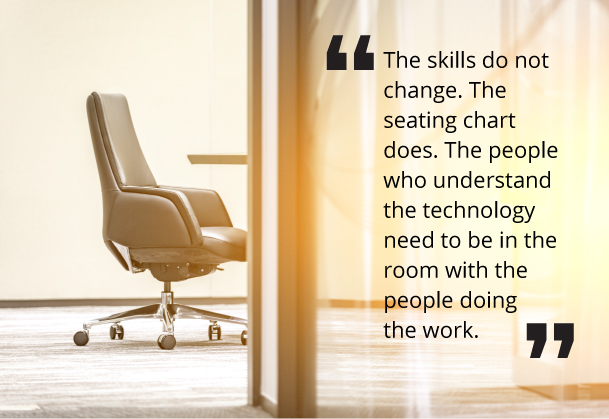
Put the technologist in the office, not in the queue. The registrar's office does not need a ticketing relationship with someone who understands prompt construction, data handling, and FERPA simultaneously. It needs that person at the staff meeting, in the room where the workflow is being designed, early enough to shape it. This is the regrouping, and like the print shop it works because of proximity rather than process. The skills do not change. The seating chart does.
Trade enforcement for education, and resource it like education. If the tools are already in everyone's hands, the only durable control is the judgment of the person holding them. That makes IT's central function pedagogical, which is an uncomfortable identity shift for a unit organized around service levels and uptime. It means teaching people what these systems do badly, where the data goes, what a confident wrong answer looks like, and when to stop and ask. It means the acceptable use policy is a syllabus, not a fence. On a campus this is less foreign than it sounds; we already have an institution that does nothing but develop judgment, and it is possible that IT and the faculty have more in common now than either has historically believed.
Name the corrector. Somewhere in your new workflows there is a chair that nobody is sitting in: the person who reads the output before it becomes a decision, who knows the subject well enough to catch a plausible error and the system well enough to know why it was produced. That role has no guild. It is not in anyone's position description. It is not IT's job, because it requires domain knowledge, and it is not purely the functional office's job, because it requires knowing how the tool fails. Most institutions are currently filling that chair by accident, with whoever happens to be conscientious, and calling the result a culture of care. It is not a culture. It is an unassigned duty, and it will be discovered the first time nobody performs it.
Make It Explicit
There is a version of this argument that ends in anxiety about replacement, and it is the wrong ending.
Working with a community college recently, I kept returning to the same phrase: make it explicit. The skills that institution taught were the right ones. Evaluating a source. Structuring an argument. Knowing which question to ask first. Recognizing when an answer is too clean. Those capacities were not obsolete; they had simply been allowed to remain tacit, carried inside disciplinary practice and demonstrated through artifacts that everyone agreed to treat as proxies. When the proxy stops being reliable, the tacit skill has to be named, taught, and assessed directly—or it disappears into the assumption that students arrive with it.
The same is true of the enterprise. The print shop did not invent new competence. It took craft knowledge that had lived inside separate guilds, as habit and apprenticeship and the way we do it here, and forced it into the open, because the work could no longer be handed across a boundary. People who had never had to articulate their standards suddenly had to explain them to someone standing three feet away with entirely different training.
That is the demand AI is making on the enterprise, and it is why the license audit was good news badly framed. Eleven subscriptions in seven offices is not a controls failure. It is eleven pieces of evidence that the shop has already regrouped, that work is being done in configurations nobody designed, and that the institution has not yet made explicit what it expects of the people doing it.
The abbot of Sponheim wrote a treatise instructing his monks to keep copying, and then had it printed. He was not a fool. He understood that something was ending and that the loss was real. What he could not see was that the question had already moved past him—that it was no longer whether the monks would keep copying, but what kind of shop would exist, who would work in it, and what they would be expected to know.
Your audit answered the first of those. The other two are yours.