
Powering Institutional Growth Through Trusted Data, AI, and Digital Innovation
 As a next-generation business and technology consulting firm, Slalom helps organizations navigate strategy, technology, and transformation with the support of more than 700 technology partners worldwide. Known for blending local relationships with global capabilities, the firm works across people, processes, and technology to help leaders move quickly in an increasingly complex environment shaped by data and artificial intelligence. Slalom’s Global Industry Director for Education, Jennie Wong, Ph.D., describes the organization as a “Goldilocks size” firm; large enough to scale and deliver quickly, while still providing a more personalized, high-touch experience. “We have the ability to provide a boutique experience, but with a lot more ability to scale,” she explains. “Slalom’s strong local presence and community focus differentiate us from traditional consulting firms, and we are deeply committed to the communities where we live and work while bringing national and global expertise to our clients.”
Slalom partners with higher education leaders to help them navigate from strategy through execution, including stakeholder alignment, systems integration, adoption, training, and change management. “Higher education transformation requires strategy, technical depth, and cultural savvy,” says Wong. “Leaders need to align innovation investments to the broader institutional mission, bring many stakeholders along, and implement new tools that connect with existing systems including cloud infrastructure, data platforms, and systems like the learning management system (LMS). Slalom brings the end-to-end expertise to support that journey, from vision to integration to adoption.”


“For university IT leaders, there’s a risk with every handoff. Traditional strategy firms are, by their nature, designed to transfer responsibility for execution. And while execution-focused firms may be able to offer competitive pricing, they may lack strategic context or require a lot of hands-on direction from an internal team that is already stretched.”
– Jennie Wong, Ph.D.
Global Industry Director for Education
Slalom

Establishing Early Alignment
One of the biggest challenges facing higher education institutions today is turning promising technology pilots into scalable solutions that deliver measurable mission and business value. “Many institutions are launching pilots, proof-of-concepts, and initial experiments with new technology, and that’s absolutely the right place to start,” Wong says. “But the real challenge comes when you try to cross the chasm from ‘this was an interesting pilot’ to ‘how do we scale this to create actual impact?’ That’s where the need to co-create and socialize an aligned vision becomes critical. We recently partnered with one of the nation’s largest universities to help support a data- and AI-driven initiative focused on career readiness and employability. This is an increasingly important priority for institutions looking to demonstrate the long-term value of higher education and improve outcomes for graduates entering the workforce.”
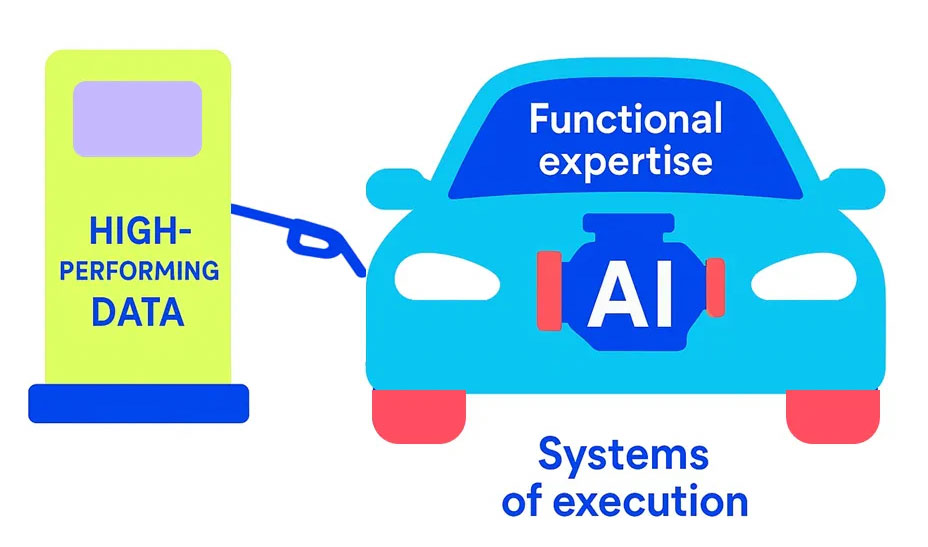 With the potential to accelerate institutions toward their missions, AI integrated into a holistic model can help organizations move faster, make smarter decisions, and unlock new opportunities for growth. Wong compares this approach to a high-performing vehicle, where each component plays a critical role in driving results. “AI in all its forms, whether machine learning, generative AI, or AI agents, can be thought of as the engine powering growth and innovation across an institution. But even the most powerful engine needs direction, which is where functional and domain expertise act as the steering wheel, guiding initiatives in areas such as enrollment, student success, alumni engagement, and fan experiences. Systems of execution, including student information systems (SIS), LMS, payment, ticketing, and donation platforms, are where the rubber meets the road, turning strategy into real-world action. Underpinning the entire vehicle is high-performing data, serving as the fuel that creates a trusted foundation for insights, informed decisions, and measurable outcomes.”
While partnering with the university on its AI-driven initiative, Slalom found broad agreement that data and AI could play a valuable role in supporting student career readiness. The greater challenge, however, was aligning stakeholders around a shared vision for the student journey and identifying how technology could enhance rather than replace existing resources. “The role of the data and AI solution was to stitch together the incredible resources they already had,” Wong explains. “No career services team has enough staff to personally remind every student about upcoming career fairs, internships, or networking opportunities, but an AI agent can do those things beautifully. Similar to automated reminders from your doctor, they can be simple and impactful, and now they can be hyper-personalized to your specific career aspirations.
“Our best practice is to bring together the right stakeholders to understand the end-to-end value chain and prioritize the most valuable first use cases for AI implementation. Establishing that alignment early is essential because long-term success depends less on the technology itself and more on whether people see value in the solution and are motivated to use it. Projects don’t usually succeed or fail on whether the technology works when you click it, but whether people agree this is something worth having and are excited to adopt the solution.”
“What I appreciated about EdgeCon’s spring session was being able to share our recent implementation of generative AI for academic feedback at UCLA’s Anderson School of Management. I think the session resonated with attendees because it moved beyond theory and into a concrete example of how institutions can translate data and AI investments into measurable value. We were able to describe not just the strategic intent, but also the guardrails and the technical architecture, including the large language model (LLM) platform and how it was integrated with the university LMS. Being able to pair strategy with that level of specificity helps people understand what’s actually possible.”
– Jennie Wong, Ph.D.
Global Industry Director for Education
Slalom

Building a Deeper Advisory Relationship
As organizations deepen their engagement with consulting partners, the relationship often evolves from strategic projects into a more embedded advisory model built on trust, context, and long-term value creation. “There’s a big difference between what I call ‘Project One’ and ‘Project Two,’” says Wong. “The initial engagement is often more tactical. It could be a workshop, support with cloud cost optimization, or helping provide additional project management or technical capacity. The focus is about getting to know each other and building familiarity.
“That early work sets the foundation for a more strategic partnership, where the focus shifts from delivery to becoming an extension of the client’s team. What that ideally leads to is trust in Slalom as an advisor, a thought partner, and even a scaling function across cloud, data, AI, or communications teams. One of the highest compliments we receive is when clients say they feel like we are a member of their team.”

When working with consulting partners, higher education leaders often describe a familiar tension: some firms excel at early strategy and then step away during execution, while others focus narrowly on delivery without contributing meaningful upstream thinking. “For university IT leaders, there’s a risk with every handoff,” says Wong. “Traditional strategy firms are, by their nature, designed to transfer responsibility for execution. And while execution-focused firms may be able to offer competitive pricing, they may lack strategic context or require a lot of hands-on direction from an internal team that is already stretched.”
By contrast, Slalom’s approach is designed to span the full lifecycle of an initiative — from strategy and planning through execution and implementation. “The value proposition is that we’re going to be with you the whole journey,” notes Wong. “When we’re doing strategy, road mapping, or experience design upfront, we’re already thinking about implementation because we’re accustomed to having to build that process. Like an architect who is also responsible for construction, one team ensures the vision is both creative and structurally executable, reducing the disconnect that often emerges between design and delivery.”

“AI in all its forms, whether machine learning, generative AI, or AI agents, can be thought of as the engine powering growth and innovation across an institution. But even the most powerful engine needs direction, which is where functional and domain expertise act as the steering wheel, guiding initiatives in areas such as enrollment, student success, alumni engagement, and fan experiences. Systems of execution, including student information systems (SIS), LMS, payment, ticketing, and donation platforms, are where the rubber meets the road, turning strategy into real-world action. Underpinning the entire vehicle is high-performing data, serving as the fuel that creates a trusted foundation for insights, informed decisions, and measurable outcomes.”
– Jennie Wong, Ph.D.
Global Industry Director for Education
Slalom
 Providing Cross-Industry Perspective
Higher education is at a pivotal moment with artificial intelligence, moving rapidly from early experimentation toward full operational deployment. “There are two differentiators that are important, because AI is a noisy space right now,” says Wong. “Every person you talk to in 2026 is going to tell you they do AI and can help you with AI. Successful universities and their partners are focused on rigor around mission impact and business value so that the investment is rationalized. Real success is not having 100 pilots, it’s being able to point to a valuable process that returns measurable impact, whether that’s mission-driven outcomes like retention and student success, or financial efficiency in service operations.
“In higher education, we don’t ascribe to the belief that all value is measured in dollars and cents. Value can also be seen in retention rates, student success metrics, and other outcomes that matter deeply to institutions. The second critical differentiator is the strength of an institution’s underlying data strategy. The university-wide data foundation is the fuel for scaling artificial intelligence, whether it’s generative, agentic, or whatever comes next. Data maturity underneath those use cases is no longer optional, it’s essential to moving from pilot to scale.”
At the C-suite level, the value of a consulting partnership is often defined less by individual projects and more by its ability to accelerate progress, remove barriers, and bring informed perspective to complex decisions. “The relationship between Slalom and our C-level clients is about feeling like an extension of the core team,” shares Wong. “We’re able to not only accelerate what an institution is already trying to do, but also help unstick things that have gotten stuck. Senior leaders also benefit from access to broader cross-industry insight. We can provide perspective from beyond higher education. There are lessons from other regulated industries dealing with data privacy and security challenges that are very relevant to higher ed as well.”
Slalom’s value proposition can be distilled into three core elements: trust, perspective, and embedded execution. “The foundation starts with building a track record of trust,” says Wong. “Then earning the right to bring in insights from other higher education institutions as well as cross-industry experience, and finally being able to execute in a way where we are truly embedded alongside their teams.”
Sparking Broader Thinking
Slalom partnered with UCLA Anderson School of Management to develop an AI-powered Academic Feedback Intelligent Assistant (AFIA) using Amazon Bedrock and Canvas LMS integration. The solution was designed to streamline assignment feedback, reduce educator workload, and improve consistency while keeping instructors involved in the review process.
At EdgeCon’s spring session, Wong was joined by fellow Slalom director, Mariola Pogacnik, to discuss this project and ways institutions can leverage AI to support the teaching and learning process within clear ethical boundaries. “Edge is an amazing platform for sharing best practices and sharing inspiration,” says Wong. “What I appreciated about EdgeCon’s spring session was being able to share our recent implementation of generative AI for academic feedback at UCLA’s Anderson School of Management. I think the session resonated with attendees because it moved beyond theory and into a concrete example of how institutions can translate data and AI investments into measurable value. We were able to describe not just the strategic intent, but also the guardrails and the technical architecture, including the large language model (LLM) platform and how it was integrated with the university LMS. Being able to pair strategy with that level of specificity helps people understand what’s actually possible.”
The response from attendees reinforced the importance of designing solutions that align with the realities of higher education today. “One of the things that received positive feedback was how intentionally the solution was designed around higher education culture,” shares Wong. “We were explicit about the current social contract between students and institutions, which is why we kept the instructor as the human in the loop and ensured outputs were fully editable and correctable. The Edge community creates space for those kinds of shared insights to spark broader thinking across institutions. It’s there to accelerate instructors, not replace their judgment. The reactions in the room showed that when solutions are designed with that cultural awareness, they resonate much more deeply than technology alone. Our partnership with Edge reflects a broader commitment to sharing practical innovation and real-world lessons across the higher education community and ensuring AI is implemented in ways that strengthen human connection, empower educators, and help institutions better serve the people at the center of learning.”