
From Data to Decisions
How HelioCampus is Helping Transform Institutional Performance in Higher Education
In an era where institutions are facing mounting pressures and increasingly complex demands, higher education leaders require more than raw data to make informed decisions. Translating that data into useful insights that inform meaningful, mission-driven strategies demands the right analytical infrastructure. HelioCampus was purpose-built to provide exactly that. Primarily developed at the University System of Maryland, the platform was conceived not as a commercial product adapted for academia, but as a solution forged from the operational realities of higher education itself. HelioCampus offers a unique perspective on using data to facilitate meaningful conversations that spur action and support greater institutional health and performance.
The perspective HelioCampus brings to this work coincides with the career path of its founder and CEO, Darren Catalano. A self-described “data guy,” Catalano built his early career across the telecom industry before transitioning to higher education in 2006, where he served as Associate Vice President of Institutional Effectiveness and later Vice President of Analytics at the University of Maryland Global Campus (UMGC). His academic grounding in Financial Economics at the University of Virginia further shaped a leadership philosophy centered on rigorous analysis, accountability, and long-term institutional value; all principles that remain foundational to HelioCampus today.
Having navigated higher education from both sides of the table, Catalano brings an uncommon depth of perspective to the platform’s mission. “I have seen these challenges previously as a university administrator and now as an ed-tech partner,” he notes. “That experience shapes everything about how we approach this work.” That commitment has recently taken on new personal meaning as well. With his oldest daughter entering the college application process, Catalano says, “I am now viewing these institutions not just as a partner, but as a parent looking for value and durability.”
“When I was serving as Vice President of Analytics at UMGC in the early 2010s, the institution was experiencing unprecedented enrollment volatility and fiscal pressure very similar to what many institutions are navigating today. We were looking at a forecasted $60 million operating deficit. Three years later, after fundamentally restructuring the institution, we had turned that into a $50 million surplus. It was part of that surplus that was used to start HelioCampus. The problems we built this platform to solve are the same problems we once had to solve ourselves.”
– Darren Catalano
Founder & CEO
HelioCampus

A History Rooted in Higher Education
HelioCampus’s roots in higher education run deeper than most ed-tech companies and its origin is one of the great strengths of the company. “During that time, we didn’t just study the challenges facing higher education from the outside, we lived them,” explains Catalano. “When I was serving as Vice President of Analytics at UMGC in the early 2010s, the institution was experiencing unprecedented enrollment volatility and fiscal pressure very similar to what many institutions are navigating today. We were looking at a forecasted $60 million operating deficit. Three years later, after fundamentally restructuring the institution, we had turned that into a $50 million surplus. It was part of that surplus that was used to start HelioCampus. The problems we built this platform to solve are the same problems we once had to solve ourselves.”
“That experience gave us deep empathy for the realities of institutional finances and operations,” continues Catalano. “Not just the data, but the culture around the data, the internal dynamics, the pressure that leaders are under. I think that’s what truly separates us from solutions that were built in the corporate world and later adapted for higher education. We know what it feels like to sit on the other side of the table.”
That founding experience laid the groundwork for a thesis that has only grown more urgent with time. Now marking more than a decade in the market and serving over 150 client institutions, HelioCampus anticipated the pressures bearing down on higher education long before they became a crisis. “The premise of HelioCampus was always business performance management for higher education,” says Catalano. “Our whole thesis was that higher education, over time, was going to have to operate much more efficiently. Mission-driven institutions still have to obey the laws of economics, and one of my catchphrases has always been that the laws of economics are undefeated at all times. You can only defy them for so long before they catch up with you.”
“From 2015 to 2020, the pressures were real but not acute,” continues Catalano. “Then came the pandemic, which exposed exactly what revenue disruption could look like. The federal stimulus that followed delayed the reckoning rather than resolved it. By 2024, institutions really felt the pinch. Then came the new administration, the Dear Colleague letters, the executive orders, the budget reconciliation bill, and a wave of state-level legislation targeting higher education. We now sit at the pinnacle of a historic dislocation. Every major revenue stream is under pressure, from net tuition revenue to research funding to endowments. This is why High Stakes. Higher Education reflects not just our brand, but the reality facing institutions today.”
“For us as an ed-tech vendor, the benefits are equally compelling. Pre-negotiated terms streamline procurement on our end as well, reducing the overall cost and complexity of contracting. And from a go-to-market perspective, EdgeMarket provides a meaningful distribution channel that extends our reach well beyond direct sales and marketing. It is a genuine win-win. Going through an RFP process can be time consuming and resource intensive for everyone involved. EdgeMarket gives institutions the ability to weigh those trade-offs and often move forward with confidence without the burden of a full procurement cycle."
– Darren Catalano
Founder & CEO
HelioCampus
Three Seismic Shifts Redefining Higher Education
With a 2026 theme of Sustain through Anything, Catalano outlines both the urgency and the opportunity that defines the work ahead. “The era of easy enrollment growth and unconstrained spending is over. It has been replaced by a hyper-focus on accountability, financial sustainability, and a question that every prospective student and family is asking: is this degree still worth it? The decisions institutions are making right now are not incremental. Leaders are determining how to respond to enrollment, retention, and demographic shifts before they become structural risks. They are deciding which programs to grow and which to sunset, and how those choices affect students, faculty, and institutional reputation. They are balancing missions with margin at a moment when resource scarcity is becoming the new normal. They are also being asked to justify all of it to boards, faculty, and external stakeholders with clarity and credibility.”
At the same time, administrators are working to understand how artificial intelligence can make university operations more efficient without surrendering institutional control. “The AI question alone represents an entirely new frontier of decision-making, but these pressures have not emerged in isolation,” says Catalano. “They have coalesced into three major shifts that will define higher education in the year ahead. The first is the move from instinct to evidence. Fiscal health is no longer a talking point, but an existential metric. Accreditation bodies like the Higher Learning Commission (HLC) and the Southern Association of Colleges and Schools Commission on Colleges (SACSCOC) have moved from cursory reviews of past financial audits to demanding forward-looking evidence of sustainability. Five-year projections and program-level ROI data are now requirements simply to maintain your license to operate. Institutions must rationalize their cost structures. On the administrative side, that means centralization and shared services. On the academic side, it means deeply understanding the cost of instruction, contribution margins, and cross-subsidies.”
Program-level accountability has emerged as the second defining shift, driven by a wave of external intervention that is reshaping academic decision-making. “We are seeing legislative intervention at a scale higher education has never experienced,” says Catalano. “Some states are mandating efficiency through teaching load requirements and program elimination criteria. At the federal level, the Earnings Premium requirement has fundamentally changed the game. If your graduates do not earn more than those with a high school diploma, your program’s eligibility for federal loans is now at risk. Accreditors are following suit, asking whether a student can recoup their investment within ten years. We can no longer afford to guess at student outcomes or the cost of instruction. A much higher level of fidelity is now required to measure student learning, post-graduation earnings, and the true economics of the academic mission.”
The third shift addresses what has become the most discussed and least resolved challenge: artificial intelligence. “Student adoption of AI has been the fastest technological uptake in history, but institutional integration is significantly more cautious,” notes Catalano. “The hype cycle is descending, and the pilot projects are maturing, while the hard work of governance is beginning. With hiring freezes and limited budgets, AI is no longer a novelty. It is the team member you wish you could hire. Adoption will be cautious, targeted, and necessity driven. Trusted AI requires trusted data. Generic AI models do not understand your institution. Without high-quality, well-governed data, AI implementation will fail. The institutions that win with AI will not be the ones that experiment the fastest. They will be the ones that govern their data the strongest.”

“If there is one thread connecting all of this, it is that the economics of higher education are now undeniably shaping our future,” says Catalano. “For too long, we treated margin as a pejorative term and data governance as a technical chore. That has to change. Rationalizing a cost structure is not anti-mission. Mission and margin are not enemies. They are partners. The institutions that thrive in 2026 will be the ones asking the hard questions: Can we defend our cost structure? Do we understand our cost of instruction? Are we governing the data that powers our decisions? And can we prove that our students are learning what we say they are learning, and that it translates into the post-graduation success they expect? The goal is not achieving efficiency for its own sake. The goal is durability. Durable institutions can take risks, invest in innovation, and protect access, while fragile institutions can only react. In this next era, clarity is not optional, but how we protect the mission.”
Bridging the Gap Between Data and Decisive Action
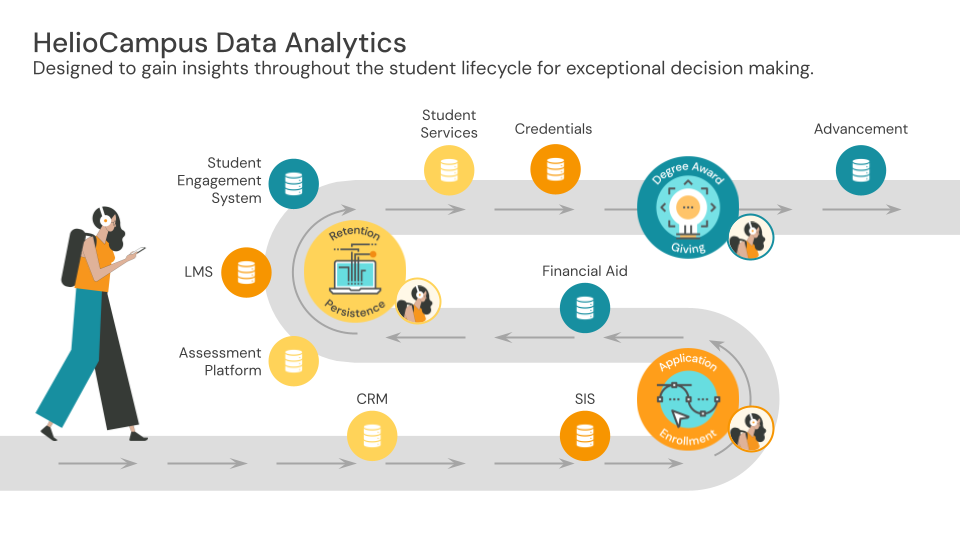
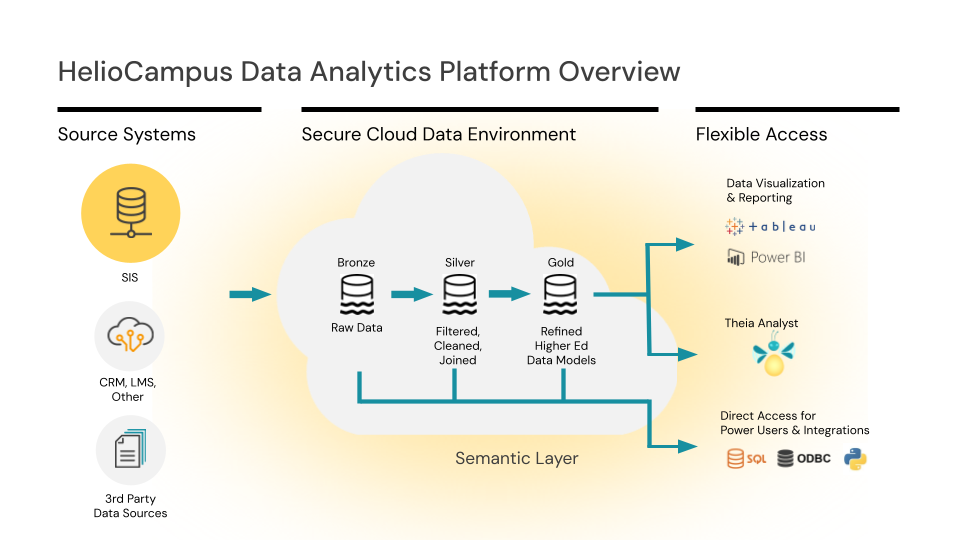
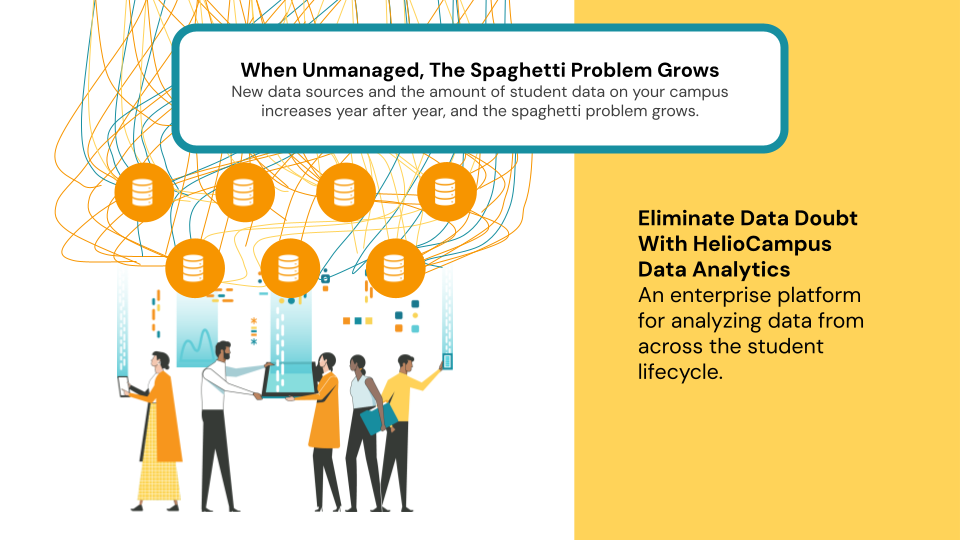
Understanding the stakes is a critical starting point, but the defining challenge for most institutions is bridging the gap between data and decisive action. “Higher education is data-rich but insight-poor,” says Catalano. “A student leaves data breadcrumbs everywhere across their journey. You have a CRM, a student information system, a learning management system, a financial aid system, a financial management system, and an HR system. The data being generated is enormous, and the challenge is making sense of it. We think about this work in three layers. The first is building the data foundation: the pipelines and governed data models that organize information across the full student lifecycle, from initial inquiry through degree completion.”
“The second layer is insights,” continues Catalano, “Once the data is organized, determining how to use that information to drive decisions. That is where we do enrollment forecasting, yield modeling, financial aid sensitivity analysis, student risk scoring, course demand planning, and contribution margin analysis at the program and department level. Faculty utilization, course scheduling efficiency, administrative cost structures. This is where data becomes actionable. The third layer is AI integration. We now have the ability to present this governed, structured data to AI applications, including our own platform, which we call Theia Analyst. Think of it as an agent control system that allows our tools, and other institutional tools, to draw on high-quality data for AI-driven analysis and workflow integration. That third layer is where the future of this work lives.”
"From 2015 to 2020, the pressures were real but not acute. Then came the pandemic, which exposed exactly what revenue disruption could look like. The federal stimulus that followed delayed the reckoning rather than resolved it. By 2024, institutions really felt the pinch. Then came the new administration, the Dear Colleague letters, the executive orders, the budget reconciliation bill, and a wave of state-level legislation targeting higher education. We now sit at the pinnacle of a historic dislocation. Every major revenue stream is under pressure, from net tuition revenue to research funding to endowments. This is why High Stakes. Higher Education reflects not just our brand, but the reality facing institutions today."
– Darren Catalano
Founder & CEO
HelioCampus
Activating and Operationalizing Data
With the data foundation in place, the conversation turns to where AI fits into the picture and what this technology means for institutional decision-making. “AI is a broad, ubiquitous term that means a lot of things on a college campus, and institutions need a broad AI strategy to address it,” says Catalano. “But regardless of where that strategy leads, the foundational principle remains the same: trusted data equals trusted AI. Our specific focus within that broader landscape is AI for decision support. Our flagship AI product, Theia Analyst, is not designed primarily for the institutional research or IT staff who already live inside the data every day. This solution is designed to activate and operationalize data by getting it into the hands of program coordinators, department chairs, deans, and enrollment managers. By removing technical barriers and delivering data in context, AI can serve as a genuine thought partner for academic and functional leaders who have historically been one step removed from the analysis driving institutional decisions. The greatest opportunity is not in making data experts more efficient, but in making every leader data capable.”
The promise of AI in institutional decision-making is only as strong as the governance structure and guardrails put in place to ensure the data powering those decisions can be trusted. “As a casual user, a chatbot makes quick work of almost anything you throw at it,” says Catalano. “But pointing AI at institutional data is an entirely different challenge. The context and industry-specific knowledge required to get accurate results is immense. A department chair asks: how many enrollments do I have in my physics program this year? That seems straightforward, but an experienced IR analyst knows otherwise. Do you mean course registrations? FTE? Deduplicated headcount? Physics majors or students who took physics courses? Academic year, fiscal year, or term? The AI has to understand what you mean, not just what you said.”
To address this challenge, HelioCampus has built a semantic layer on top of their core data foundation. “Think of the semantic layer as the instruction manual that bridges the gap between a question and the right answer,” explains Catalano. “The semantic layer establishes defaults, interprets institutional terminology, and ensures that when a leader asks a question, the response reflects the data they actually need. Beyond that, you want to ground the AI’s analysis in established best practice research rather than allowing the tool to draw freely from the open internet. If your institution follows the National Institute for Student Success framework, for example, that becomes the reference point for all student success recommendations. Guardrails like these are not limitations on AI. They are what make AI trustworthy.”

Client Success Stories
More than 150 institutions have turned to HelioCampus to transform data into informed decision-making and measurable results. Check out their success stories at heliocampus.com/client-success-stories.
 Easy Procurement of HelioCampus Solutions
For institutions looking to move quickly in a resource-constrained environment, HelioCampus’s availability through EdgeMarket represents a significant practical advantage. “We love working with Edge, and the value proposition runs in both directions,” shares Catalano. “For institutions, the ed-tech landscape is an enormous and often overwhelming ecosystem of vendors, products, and categories. Edge cuts through that noise by offering a curated list of fully vetted vendors with pre-negotiated contracts. That saves institutions a significant amount of research, time, and effort. The platform also simplifies what can be an extraordinarily complex state procurement process.”
“For us as an ed-tech vendor, the benefits are equally compelling,” continues Catalano. “Pre-negotiated terms streamline procurement on our end as well, reducing the overall cost and complexity of contracting. And from a go-to-market perspective, EdgeMarket provides a meaningful distribution channel that extends our reach well beyond direct sales and marketing. It is a genuine win-win. Going through an RFP process can be time consuming and resource intensive for everyone involved. EdgeMarket gives institutions the ability to weigh those trade-offs and often move forward with confidence without the burden of a full procurement cycle.”
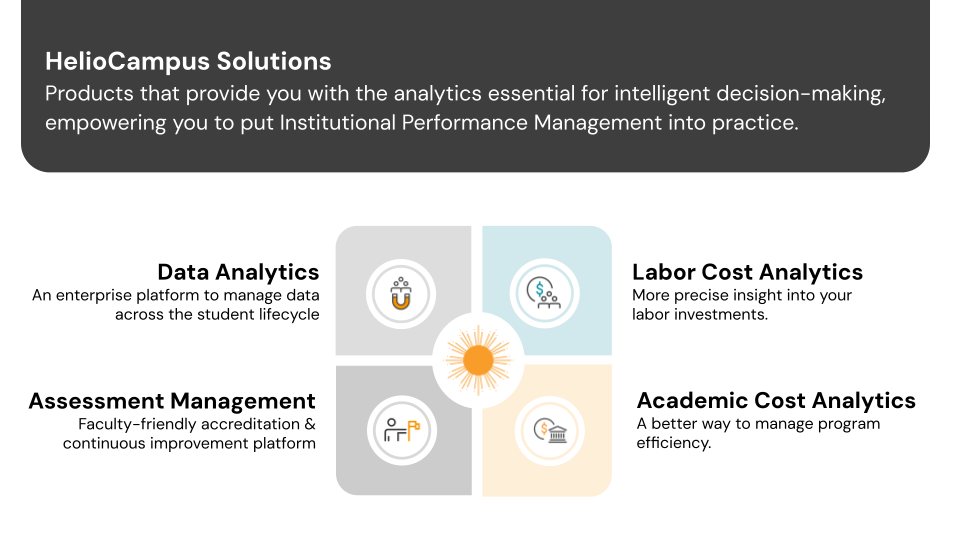
The value of streamlined procurement is only meaningful when the platform it delivers produces real, measurable results. “The core tenets of institutional performance management have always been about impact and outcomes,” says Catalano. “Everything we do helps institutions drive enrollment, student success, and net tuition revenue, align expenses with revenues, and measure and improve learning outcomes. Those three tenets have never been more important than they are right now. In an era defined by financial pressure, legislative scrutiny, and rapidly shifting student demographics, that clarity of purpose may be HelioCampus’s most valuable offering of all. The data exists and the tools are in place. The question facing every institution today is whether they are ready to act on what the evidence is telling them and transform that insight into the resilience their students and communities depend on to access opportunity, build careers, and help shape their futures.”
Turn your institution’s data into actionable insights for driving enrollment, controlling expenses, and improving learning outcomes. Learn more about HelioCampus’s Institutional Performance Management platform available through EdgeMarket at edgemarket.njedge.net/home/heliocampus-institutional-performance-management-2025.