
Turning Passive Learning into Active Student Experiences
As higher education institutions continue to expand digital learning opportunities, video has become a critical tool for creating more engaging and interactive student experiences. At the center of that shift is WeVideo, a video learning platform designed to help faculty and students move beyond passive content consumption and into active participation and collaboration. Built for the evolving needs of today’s learners, WeVideo enables educators to create compelling multimedia projects and transform traditional video into interactive learning experiences enhanced with assessments, analytics, and real-time engagement tools.
WeVideo's mission centers on turning passive viewers into active learners and helping streamline multimedia creation across campus. “Recent research shows students in traditional lecture courses are about one and a half times more likely to fail than students in active learning environments,” shares Rob Sparks, Chief Strategy Officer, WeVideo. “While many faculty are receptive to the idea of active video and want to move beyond lecture capture, they're resistant to anything that adds workload without giving them something back. However, when a faculty member sees analytics from an interactive video and realizes they can finally see where students are getting lost—not at the end of a unit, on the assessment, but inside the content itself, in the third minute, on a specific concept—that changes the conversation from ‘new tool’ to ‘new visibility.’ After that, the resistance isn't about video anymore, but whether the institution will support them in rethinking the surrounding pedagogy.”
Creating and Communicating through Multimedia
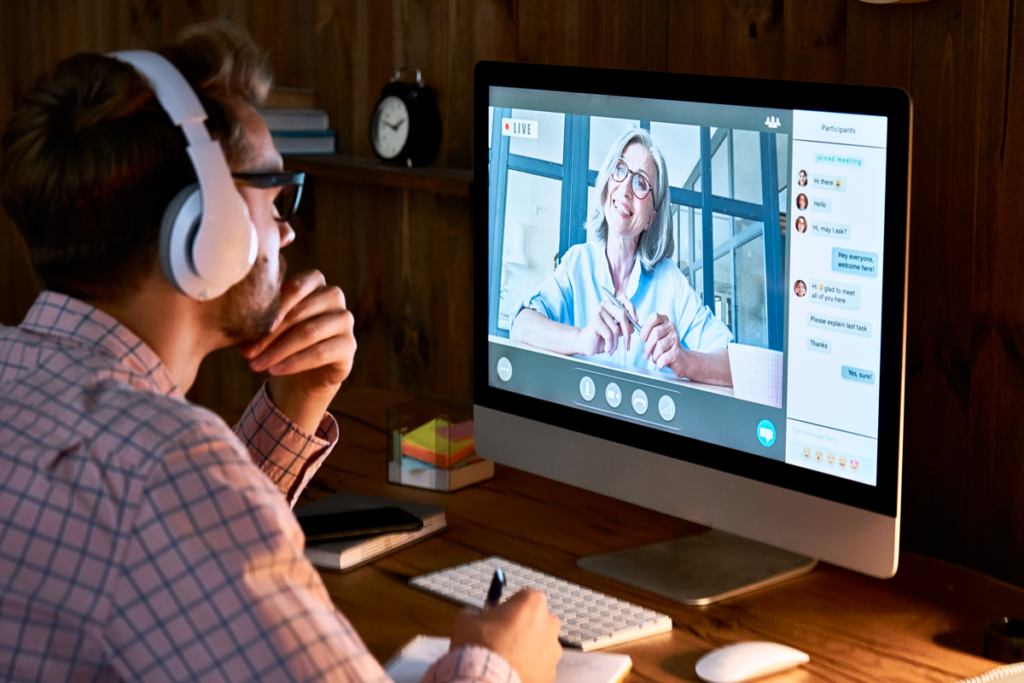
Video is becoming more embedded in higher education, where many institutions are rethinking its role not just as a tool for delivering content, but as a core component of how students learn, communicate, and demonstrate readiness for the workforce. For WeVideo, the shift reflects a broader change in both education and hiring; one where the ability to create and communicate through multimedia is becoming just as important as traditional academic performance. “Consumption and creation aren't two ends of a spectrum, but two halves of the same competency,” says Sparks. “Watching a video and being able to engage critically with it is one skill. Being able to produce a video that communicates clearly is a different, and arguably a more valuable, skill. Every graduate will likely need to exercise this ability in their professional life within months of leaving campus.”
“There's a labor market shift underneath this that I think is underappreciated,” continues Sparks. “As recently as 2019, around three-quarters of employers used GPA as a screening tool in hiring. By this year [2026], that number is closer to four in ten. The hiring conversation has moved from credentials-as-proxy to demonstrable skills. Increasingly, video is becoming one of the clearest ways students can showcase what they know and how they communicate. A nursing student recording a patient communication scenario, an engineering student walking through a design rationale, a business student pitching a case analysis. These aren't classroom exercises; they're the artifacts that will travel with that student into a job interview.”
WeVideo approaches video learning from two angles: helping students engage more actively with content and giving them the tools to confidently create their own. The platform is designed to make both sides of the experience accessible, even for users with no background in video production. “The learning outcomes we see when institutions lean in are pretty consistent,” says Sparks. “Deeper retention because students externalize their reasoning, stronger communication competencies that show up in employer feedback, and better equity outcomes, because video gives students who aren't the loudest voice in a seminar room a different surface to demonstrate mastery.”
“There's a labor market shift underneath this that I think is underappreciated. As recently as 2019, around three-quarters of employers used GPA as a screening tool in hiring. By this year [2026], that number is closer to four in ten. The hiring conversation has moved from credentials-as-proxy to demonstrable skills. Increasingly, video is becoming one of the clearest ways students can showcase what they know and how they communicate. A nursing student recording a patient communication scenario, an engineering student walking through a design rationale, a business student pitching a case analysis. These aren't classroom exercises; they're the artifacts that will travel with that student into a job interview.”
– Bob Sparks
Chief Strategy Officer
WeVideo

Strengthening Faculty-Student Connection
 With features such as embedded assessments, discussion tools, and real-time analytics, WeVideo helps instructors better understand student engagement and turn video from a passive experience into a more connected learning environment. “Instructional designers (ID) use the platform differently than faculty do, which is one of the more interesting things we've watched develop,” shares Sparks. “IDs use the aggregate data, like drop-off curves and question-level performance, to redesign content. They'll come back to a module and say, ‘the third explanation in the second video is where we lose forty percent of the cohort,’ and they'll rebuild it. That level of iteration was difficult for faculty in the past because they lacked visibility into how students were engaging with the content.”
 “Faculty use the platform more individually,” adds Sparks. “For example, determining which students to reach out to before the next class. This is a kind of attentiveness that doesn't scale without the data, especially in large enrollments and online programs. What surprises faculty most is the gap between perceived engagement and actual engagement. A faculty member who thought a particular topic was landing because nobody asked questions discovers nobody asked questions because users fell off before minute four. That's an uncomfortable moment, but it's the moment things start to change.
 “For a CIO audience, I'd also frame this in financial terms. The conversation about analytics is usually a pedagogy conversation, but it's also a retention conversation. Every one-percent improvement in retention is meaningful institutional revenue—hundreds of thousands of dollars at most institutions, in lost full-time equivalent (FTE) saved. The analytics aren't a feature; they're an early-warning system on an asset the institution can actually do something about.”
The WeVideo Interactive Video Learning Platform was recently added to EdgeMarket to help member institutions scale online learning initiatives with a focus on academic integrity and learning science. “When an institution evaluates a vendor through EdgeMarket, they are not starting from scratch on due diligence; the cooperative has already reviewed key areas such as vendor stability, security posture, and contract terms,” says Sparks. “For a CIO, that can turn a procurement process that once took months into something measured in weeks.”
“Being part of Edge means we cannot function as a transactional vendor; we have to show up as a partner institutions are willing to recommend to their peers,” continues Sparks. “That is a higher bar, and the right standard to strive toward. For institutions evaluating WeVideo through EdgeMarket, the cooperative relationship provides leverage we would not otherwise be able to offer, including terms, integration, and roadmap influence. We take member input into our roadmap seriously, and that feedback directly shapes how the platform evolves to better meet the needs of institutions over time.”
 Rethinking Assessment in the Age of Artificial Intelligence
With AI continuing to reshape higher education, academic integrity is becoming less about catching misconduct after the fact and more about redesigning assessments altogether. Many institutions are exploring ways to make the learning process itself more visible and creating opportunities for students to demonstrate authentic understanding and ownership of their work in real time. “Integrity is going to be the central design question for higher ed for the next several years, and I'd argue we're past the point where the answer is detection,” says Sparks. “Detection is a losing race. The real shift is toward assessments where the work itself is observable in the process of being done, and where authorship is built into the artifact rather than inferred after the fact.”
“There's a body of research on this that I think is going to shape how institutions think about AI in learning more broadly,” continues Sparks. “Stanford published an evidence-base review earlier this year on AI in education that's worth every CIO's time. One of the central findings is what they call the productive-struggle problem: AI tools can reduce a student's cognitive load and make the work feel easier and more enjoyable, but at the expense of the effortful processing that actually builds durable learning. A study they cite found students using AI to study without guardrails performed about 17% worse on unassisted exams than students who didn't have AI access at all. AI made the practice easier and the exam harder.
“This is the design problem, and it is why we believe the most important question is not whether a vendor has AI, but whether they have a clear point of view on what AI should and should not do within the learning experience. When a student records themselves explaining a derivation, defending a clinical decision, or walking through their reasoning on a case, that is observable cognition. An agentic AI can write a polished paper; it cannot stand in for a student explaining their own thinking with the camera on. The artifact and the authorship are inseparable. We help institutions shift more of their high-stakes assessment toward modalities where integrity is structural rather than enforced.”

“Meeting students’ needs requires institutions to rethink how learning experiences are designed and delivered. Community colleges in particular are now serving five generations simultaneously, including Boomers reskilling for late-career pivots, Gen X mid-career, Millennials with families, Gen Z digital natives, and the first wave of Gen Alpha through dual enrollment. Those generations don’t share modality preferences, attention patterns, or learning motivations. Meeting learners’ needs requires three things working together: modality choice—live, async, or interactive; pace choice—moving faster or slower without falling out of the cohort; and demonstration choice—showing mastery in the form that fits their strengths, whether writing, presenting, or producing. Video can serve as the connective tissue across all three, but it works best as part of a broader ecosystem of tools and approaches that support flexibility, accessibility, and meaningful demonstration of learning.”
– Rob Sparks
Chief Strategy Officer
WeVideo
Bridging Learning and Workforce Outcomes
Micro-credentials are becoming an important part of how institutions approach workforce readiness and lifelong learning. For WeVideo, that shift reflects a broader evolution in how skills and competencies are demonstrated, validated, and communicated beyond the traditional degree model. “Credentialing has become an ecosystem question rather than a single-product question, and the framing I've found most useful is the one Martin Bean has been developing—a continuum from micro-credentials, which are skill-level, to meso-credentials, which are competency clusters, up to macro-credentials, which are the traditional degrees,” explains Sparks. “The institutions doing this well are thinking about all three simultaneously, with pathways for credit running upward and pathways for recognition running outward into the workforce.”
“Where we fit is in the evidence layer underneath that ecosystem,” continues Sparks. “We don't position ourselves as a credentialing platform, but provide demonstration. A micro-credential is only as meaningful as the evidence behind it, and video is increasingly one of the most compelling ways to showcase that evidence because it captures competency in action, not just a claimed skill. While credentialing platforms manage issuance and standards, WeVideo focuses on documenting and demonstrating the learning experience that students complete to earn those credentials.
“For institutions focused on workforce development and lifelong learning, this has become increasingly important, especially in the community college space as they respond to shifting demographics and a growing population of adult learners. Hiring managers are more skeptical of credentials that are not supported by clear evidence. Video helps close that gap by providing visible, authentic demonstrations of skill. The same evidence layer can also support non-credit certificates, stackable credentials, and capstone artifacts within traditional degree programs.”
“This is the design problem, and it is why we believe the most important question is not whether a vendor has AI, but whether they have a clear point of view on what AI should and should not do within the learning experience. When a student records themselves explaining a derivation, defending a clinical decision, or walking through their reasoning on a case, that is observable cognition. An agentic AI can write a polished paper; it cannot stand in for a student explaining their own thinking with the camera on. The artifact and the authorship are inseparable. We help institutions shift more of their high-stakes assessment toward modalities where integrity is structural rather than enforced.”
– Rob Sparks
Chief Strategy Officer
WeVideo

Transforming the Learning Experience
The phrase “meeting learners where they are” is often used in higher education, but it has taken on a more operational meaning grounded in mixed modality and differentiated learning pathways. “Meeting students’ needs requires institutions to rethink how learning experiences are designed and delivered,” says Sparks. “Community colleges in particular are now serving five generations simultaneously, including Boomers reskilling for late-career pivots, Gen X mid-career, Millennials with families, Gen Z digital natives, and the first wave of Gen Alpha through dual enrollment. Those generations don't share modality preferences, attention patterns, or learning motivations. Meeting learners’ needs requires three things working together: modality choice—live, async, or interactive; pace choice—moving faster or slower without falling out of the cohort; and demonstration choice—showing mastery in the form that fits their strengths, whether writing, presenting, or producing. Video can serve as the connective tissue across all three, but it works best as part of a broader ecosystem of tools and approaches that support flexibility, accessibility, and meaningful demonstration of learning.”
“Transforming the learning experience begins with a fundamental shift in how video is understood within higher education,” continues Sparks. “Rather than treating video as a delivery tool, institutions are beginning to see it as a space where assessment, evidence, and authorship come together. This is a category-level change, not a feature change, and is one that has me most engaged strategically because it changes what institutions need from a platform like ours over the next three to five years. Student-generated content matters more now than it did even two years ago. In a skills-first labor market, the artifact a student produces is the credential. Institutions that figure out how to make student content production routine, scalable, and rigorous are going to graduate students who are visibly more employable.
“The second is what AI does to the design of learning, not just how learning is produced. The Stanford evidence base is doing the field a favor by surfacing the productive-struggle problem: AI can make learning feel easier while making the learning itself weaker. The institutions and vendors who internalize that finding are going to design very different products from the ones that don't. For us, that means being deliberate about where AI sits in the workflow: reducing creation friction for faculty; generating questions, but never standing in for the cognitive work the student needs to do. The tools needed to turn passive viewers into active learners are finally available on an institutional scale. Over the next two years, the real dividing line in higher education will be between institutions that simply deliver content and those that design active learning environments that drive deeper engagement and stronger skills development.”
 To discover how WeVideo can help ignite creativity and drive deeper learning outcomes, visit https://edgemarket.njedge.net/home/wevideo-interactive-video-learning-platform.
References:
Active learning increases student performance in science, engineering, and mathematics. Scott Freeman, Sarah L. Eddy, Miles McDonough, and Mary Pat Wenderoth. PNAS. May 12, 2014.
Skills-Based Hiring Grows, but College Students Don’t Fully Understand It. Kevin Gray and Andrea Koncz. NACE. January 23, 2026.
The Evidence Base on AI in K-12: A 2026 Review. Lily Fesler, JP Martinez Claeys, Chris Agnew, and Susanna Loeb. Stanford. 2026.