
Stop Retrofitting:
Why Embedding Instructional Design from Day One Changes Everything
As online learning continues to expand, institutions often recognize that effective course design requires more than subject-matter expertise alone. Without a strong instructional design foundation, courses may need ongoing revisions, assessments may not fully align with learning outcomes, and student experiences can vary significantly from one course to the next. Intentional, embedded instructional design can transform the way academic programs are developed and delivered and produce measurably better results. “Involving instructional designers from the beginning improves the coherence and quality of the entire program,” says Shirley Abbelard, MOT, OTR/L, Assistant Professor, Felician University. “A proactive approach helps ensure that course outcomes, program outcomes, learning activities, and assessments are intentionally connected rather than retrofitted after courses have already been developed.
“When instructional design comes after the fact, someone is always going back in to fix something that could have been built correctly from the start,” adds Laura M. Romeo, Ph.D., Director of Digital Learning Innovation, Scholarship, and Educational Services, Edge. “Faculty spend more hours than they should rebuilding courses semester after semester, trying to make things work within a structure that was never quite coherent to begin with. But the less visible cost is the student experience, and honestly, I think that's the most important one. When courses aren't connected to each other by a shared logic, students feel that. They finish a course without any real sense of how it feeds into the next one, or how the work they're doing relates to the profession they're preparing to enter. For programs preparing students for clinical or professional practice, that disconnection can genuinely affect how ready they feel when they graduate.”
“The point where the cost becomes undeniable is different for every institution, but in my experience, accreditation pressure is often what finally makes it real,” continues Romeo. “When an external review body starts asking pointed questions about program coherence and outcome alignment, institutions suddenly have a very concrete reason to care about what intentional design looks like from the ground up.” The good news is that institutions do not have to wait for these challenges to surface. A proactive approach to instructional design can help build alignment, consistency, and quality into a program from day one.
“Instructional design creates a stronger foundation for evaluating whether students are progressing toward the competencies expected of graduates. For faculty, instructional design does not replace disciplinary expertise or limit academic freedom but instead it provides a collaborative structure for turning that expertise into meaningful learning experiences.”
– Shirley Abbelard, MOT, OTR/L
Assistant Professor
Felician University

Aligning Learning Outcomes Across the Student Journey
Aligning learning outcomes across an entire program from the beginning is a hallmark of intentional design, but it requires more than simply defining outcomes. Faculty often enter the process with strong ideas about their individual courses, making it important to create a shared vision for how each course contributes to the overall student experience. “The purpose of alignment is not to limit faculty expertise but to ensure that individual courses work together to support broader program goals,” explains Romeo. “An instructional designer doesn't walk into a room knowing what a first-year occupational therapy student needs to understand about therapeutic relationships or clinical reasoning; the faculty do. What I can bring is a framework for asking how those things connect across the full program and a process that helps make that connection visible.
 “In practice, alignment means starting with the bigger picture before anyone gets into the weeds of their individual course. When faculty can see the map, where their course sits in the student's journey, what students are arriving with and where they're headed next, they're usually not resistant to alignment. They're just not accustomed to being invited into that conversation early. The problem isn't that faculty want to work in silos, it's that the systems most institutions have built sometimes don't give them any other option.”
For Abbelard, including instructional designers from the beginning of developing their occupational therapy (OT) program allowed them to approach the process much more intentionally. “As faculty, we brought expertise in occupational therapy practice, accreditation expectations, and the knowledge and skills students would need as future clinicians. The instructional designers helped us translate that expertise into a cohesive and student-centered learning experience. One of the greatest benefits was having someone consistently ask how the pieces connected. It was not only about whether an individual assignment was strong, but whether it aligned with the course objectives, whether students had been adequately prepared for it, and how it contributed to broader program outcomes. I particularly saw the value of the partnership during curriculum and course mapping. Seeing the entire sequence visually helped us identify where concepts needed to be introduced, reinforced, and ultimately demonstrated. This approach also revealed potential gaps, repetition, and workload concerns that may have been difficult to recognize while developing courses individually. The process helped us move beyond simply covering content and think more deliberately about how students would progress through the program.”
To build a coherent student journey from course one to program completion raises an important question: what does incoherence actually look like from a student’s perspective, and how is that experience different in a program designed with a clear through-line? Incoherence is often difficult for students to name, Romeo says, but easy for them to feel. “This type of misalignment can show up when courses feel disconnected from one another, when students have to work harder than expected to make the connections themselves, or when what they’re asked to do in one class seems unrelated to what they’ve learned before or will in the future. At its most frustrating, it sounds like students saying, ‘I have no idea why we're doing this,’ not because the content isn't valuable, but because the design never made the purpose clear.”
“When a program is built with a real through-line, the experience feels different from the start,” Romeo continues, pointing to how students can quickly recognize when their learning feels connected and purposeful across courses. “Students can see where they're going. Assignments build on each other in ways that feel intentional rather than coincidental. By the time they reach the capstone or exit the program, they have a sense of cumulative growth rather than a collection of separate, unrelated experiences. That coherence is something students notice when it's present, and it matters especially in professional programs where the connection between academic learning and real-world practice has to be made explicit.”
“When a program is built with a real through-line, the experience feels different from the start. Students can see where they're going. Assignments build on each other in ways that feel intentional rather than coincidental. By the time they reach the capstone or exit the program, they have a sense of cumulative growth rather than a collection of separate, unrelated experiences. That coherence is something students notice when it's present, and it matters especially in professional programs where the connection between academic learning and real-world practice has to be made explicit.”
– Laura M. Romeo, Ph.D.
Director of Digital Learning Innovation, Scholarship, and Educational Services
Edge

Designing Assessments for Authentic Practice
 The development of Felician’s graduate-level OT program demonstrates how embedded instructional design can help create a cohesive learning experience from the very beginning. As a clinically rigorous discipline with accreditation requirements and practice-based competencies built directly into the curriculum, the OT program required careful alignment between academic learning and real-world application. “Occupational therapy was a useful case study because we were not simply developing a collection of courses,” explains Abbelard. “We were building a professional program that needed to integrate accreditation standards, clinical reasoning, hands-on skills, documentation, ethics, fieldwork preparation, and entry-level practice expectations. The complexity of the program made it clear that course design could not happen in isolation.
“Students need to develop knowledge and skills progressively, with each course intentionally preparing them for what comes next. Edge’s instructional designers helped us examine the curriculum at both the course and program levels so that learning outcomes, activities, and assessments were aligned and appropriately scaffolded. In a less complex program, gaps or redundancies may not become apparent immediately. In OT education, however, a weakness in sequencing can directly affect students’ readiness for not only the program but fieldwork, and eventually clinical practice. That made embedded instructional design essential rather than simply an added layer of support.”
Romeo adds “When you're building a program that has to meet Accreditation Council for Occupational Therapy Education (ACOTE) accreditation standards, align with entry-level competency expectations, and prepare students for supervised clinical fieldwork at the graduate level, you don't have the luxury of leaving things vague. Every learning outcome has to do real work. That pressure is actually clarifying, because it makes the cost of poor design visible in ways that a more loosely structured program might not reveal. What the complexity of OT revealed is that the instructional design process has to begin with the end in mind in a very literal sense. You start with what a graduate needs to be able to do on day one of clinical practice, and you work backwards from there. That backward design logic is good practice in any program, but OT made it impossible to skip.”
Instead of simply recalling information, an authentic OT assessment requires students to interpret a client’s situation, identify occupational performance barriers, select or analyze appropriate assessments, establish functional goals, develop an intervention plan, document their reasoning, and modify their approach as the client’s needs change. “Students may be given a complex client case and asked to determine what additional information they need, prioritize the client’s concerns, choose an intervention approach, grade or adapt an activity, and write documentation that supports their clinical decisions,” explains Abbelard. “Simulations and practical examinations can also require students to respond in the moment, communicate professionally, and demonstrate safe clinical judgment.
“A traditionally designed course might rely more heavily on quizzes, exams, or isolated assignments that assess individual pieces of knowledge. Those methods still have a place, but they do not always show whether students can integrate what they know and apply it within a realistic clinical context. Embedded instructional design helped us create assessments that were aligned with professional practice while still being structured, measurable, and appropriate for the students’ level within the program.”
“Deans and provosts aren’t usually skeptical of instructional design because they don’t value learning. They’re skeptical because they haven’t seen a clear connection between design investment and the metrics. When you can show that a well-designed program produces stronger alignment with accreditation standards, fewer course revisions semester over semester, and a more coherent student experience, that’s a different conversation than ‘we think good design matters.’ From the Felician OT program specifically, I’d point to how stable the courses felt from day one of delivery. The foundation was solid going in, which meant faculty weren’t scrambling to revise things mid-semester. For a new program under accreditation scrutiny, that kind of stability has real value, and it’s something you can speak to concretely with leadership.”
– Laura M. Romeo, Ph. D.
Director of Digital Learning Innovation, Scholarship, and Educational Services
Edge

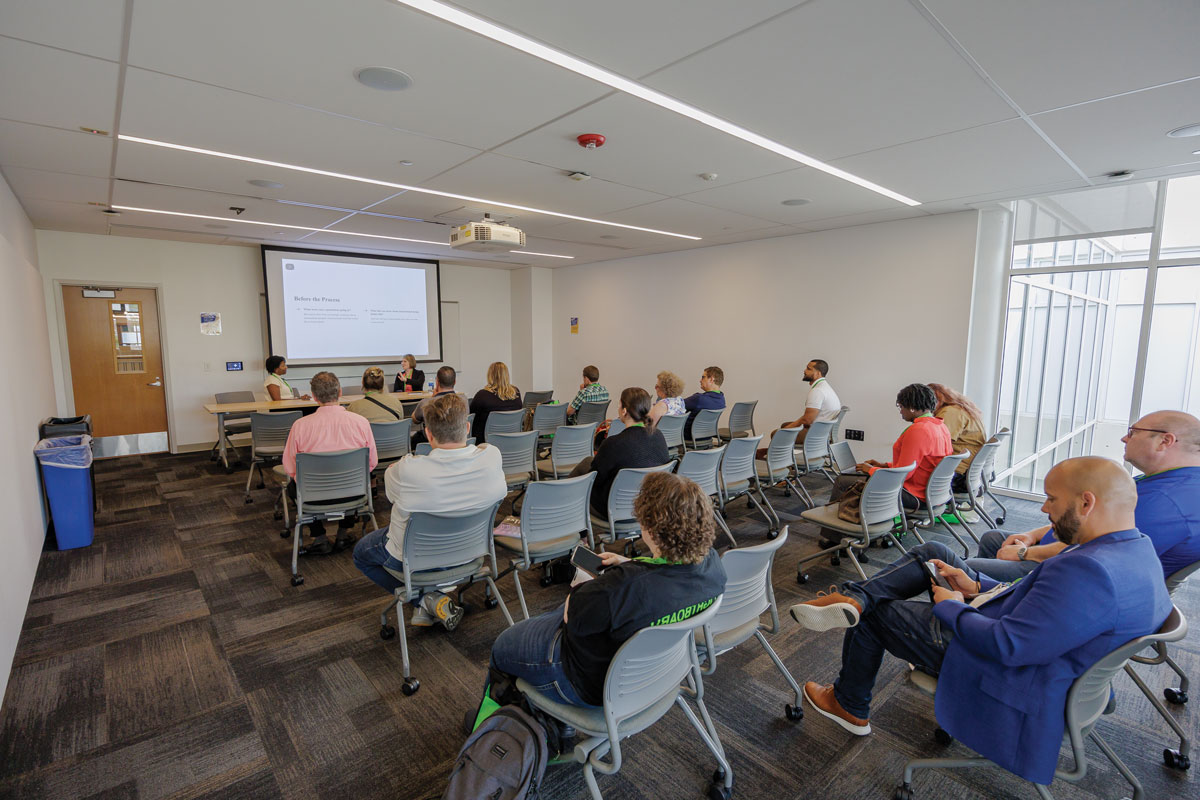
Shirley Abbelard, MOT, OTR/L and Laura Romeo presenting Stop Retrofitting: Why Embedding Instructional Design from Day One Changes Everything at EdgeCon.
Demonstrating Value to Academic Leadership
For many institutions looking to make the case for instructional design, one of the top challenges is often connecting design decisions to the initiatives academic leadership is already focused on. “The argument that tends to land is the one tied to outcomes leadership already cares about: accreditation, student success, retention, and time to completion,” notes Romeo. “Deans and provosts aren't usually skeptical of instructional design because they don't value learning. They're skeptical because they haven't seen a clear connection between design investment and the metrics. When you can show that a well-designed program produces stronger alignment with accreditation standards, fewer course revisions semester over semester, and a more coherent student experience, that's a different conversation than ‘we think good design matters.’ From the Felician OT program specifically, I'd point to how stable the courses felt from day one of delivery. The foundation was solid going in, which meant faculty weren't scrambling to revise things mid-semester. For a new program under accreditation scrutiny, that kind of stability has real value, and it's something you can speak to concretely with leadership.”
Abbelard agrees, noting that leaders often recognize that investing in instructional design strengthens program consistency, supports accreditation readiness, improves faculty collaboration, and helps identify curriculum gaps or redundancies before they become larger problems. “Instructional design creates a stronger foundation for evaluating whether students are progressing toward the competencies expected of graduates. For faculty, instructional design does not replace disciplinary expertise or limit academic freedom but instead it provides a collaborative structure for turning that expertise into meaningful learning experiences.
“Faculty still determine what students need to know and be able to do, while instructional designers help ensure that the curriculum gives students a clear and effective path toward achieving those expectations. Ultimately, embedding instructional design early is more efficient than attempting to repair misalignment later. It supports faculty, strengthens the curriculum, and gives students a superior educational experience from the beginning.”
For institutions working with programs that were retrofitted or never fully designed, it can be difficult to know where to begin. Romeo emphasizes that most institutions don’t need to start from zero. “Few programs need to start over entirely; they already contain valuable elements such as faculty expertise, effective assignments, and usable course content. What is often missing is the connective structure that ties those pieces together into a coherent whole. Starting with a program-level map can help surface that structure, including clarifying intended outcomes, revealing how each course contributes, and identifying gaps, redundancies, or misalignments in the overall design.
“The mapping process often surfaces two or three high-priority places where a targeted redesign would have the most impact. You don't have to renovate the whole house to make it livable. Sometimes strengthening the foundation in one or two critical courses changes the experience of the entire program. The goal is to start intentionally, even if the work begins in a small but strategic way. Over time, those focused improvements build momentum toward a more cohesive, well-designed program.”
Elevate Your Online Learning From Concept to Completion
Explore how Edge’s seasoned team can help design, develop, and manage your online course offerings at any stage of the process. Learn more at njedge.net/solutions/digital-learning-scholarship/edgescholar-instructional-design.