
Positioning Community Colleges as Engines or Economic Mobility and Opportunity
Recent legislation in New Jersey is creating new opportunities for the State’s 18 community colleges to expand their role in supporting students, strengthening workforce pathways, and responding to the needs of a changing economy. Signed into law as part of the New Jersey Council of County Colleges’ (NJCCC) Opportunity Agenda: Building Pathways to Equity and Economic Prosperity, a package of five bills aims to increase access to career pathways, expand support services for students, strengthen collaboration between colleges and workforce partners, and further define the strategic role of NJCCC. The legislation builds on a broader vision for community colleges as essential engines of economic mobility and opportunity. By addressing areas such as basic needs support, industry-aligned credentials, workforce partnerships, and statewide coordination, the new laws provide a framework for helping more students successfully complete their education and connect with in-demand careers.
NJCCC’s Opportunity Agenda is a statewide effort that reflects a shared commitment to ensuring community colleges remain responsive to the evolving needs of students, employers, and communities. "The Opportunity Agenda was an ambitious vision with four pillars, strategies under each pillar, and solutions designed to guide the work of all 18 colleges,” says Linda Scherr, Ph.D., Chief Academic Officer, NJCCC. “What has been remarkable is seeing it transform from a document into a living resource that colleges continue to use to benchmark their progress, learn from one another, and identify new opportunities for innovation." With the legislation now in place, New Jersey’s community colleges are building on the progress while incorporating lessons learned from implementation.
Shaping the Focus for the Future
The Opportunity Agenda also became a catalyst for turning ideas into state policy. “We wanted a policy document that would be action focused,” says Maria Heidkamp, Chief Innovation and Policy Officer, NJCCC. “Someone in the Assembly Majority Office had marked up the executive summary in great detail, identifying which ideas could move forward and which would need more work. That was the genesis of the bill package.” Five bills ultimately became law, including measures to modernize the Council’s authorizing statute, codify Pathways to Career Opportunities, strengthen collaboration between community colleges and workforce boards and social service agencies, and direct the Department of Labor to create an industry-valued credential list.
NJCCC is working with the new administration, the Department of Labor, and other state agencies to move the legislation into implementation and develop stronger systems for identifying credentials that have value in the labor market. The Opportunity Agenda has also evolved alongside New Jersey’s broader postsecondary goals.
“We could not be more excited that such a diverse group of organizations has come together to find new ways to expand opportunity for more New Jerseyans. Community colleges have a critical role to play in advancing economic and educational mobility, but we cannot do this work alone. We are stronger when we work alongside business leaders, labor organizations, four-year institutions, K–12 partners, community organizations, and others who share this commitment. You would be hard-pressed to find a more diverse group of organizations that may not agree on everything, but they do agree on one important goal: expanding opportunity and helping more New Jerseyans earn credentials and degrees that lead to good-paying jobs.”
– Aaron Fichtner, Ph.D.
NJCCC

Evolving the Community College Mission
Building on the goals of the Opportunity Agenda, NJCCC has brought together education, workforce, industry, and community leaders through the Future Ready New Jersey Coalition. This statewide partnership unites 30 organizations around a shared commitment to expanding access to high-quality education and training opportunities that connect residents with in-demand careers. By aligning efforts across sectors, the initiative aims to strengthen economic mobility, support employers’ evolving workforce needs, and help create a more resilient economy where more New Jersey residents have the opportunity to succeed.
"We could not be more excited that such a diverse group of organizations has come together to find new ways to expand opportunity for more New Jerseyans,” says Aaron Fichtner, Ph.D., President, NJCCC. “Community colleges have a critical role to play in advancing economic and educational mobility, but we cannot do this work alone. We are stronger when we work alongside business leaders, labor organizations, four-year institutions, K–12 partners, community organizations, and others who share this commitment. You would be hard-pressed to find a more diverse group of organizations that may not agree on everything, but they do agree on one important goal: expanding opportunity and helping more New Jerseyans earn credentials and degrees that lead to good-paying jobs."
“We want the Coalition to be about action, new policy, and data,” says Heidkamp. “One example is our new partnership with the YMCA State Alliance, which has about 10,000 employees across the State, 90% of whom are part-time. Many have high school diplomas as their highest level of educational attainment. We’re working with community colleges and local YMCA affiliates to help Y staff learn about career and educational opportunities. Many community college students—probably somewhere between 10% and 25% of them—are student parents. They may need child care, and can potentially get that at a Y, or they may need an internship in early childhood education. We’re trying to make it a two-way street.”
NJCCC is pursuing similar partnerships with organizations such as United Way of Northern New Jersey and public libraries, while also working with the New Jersey Institute for Social Justice on policy initiatives. One proposed initiative would establish a statewide direct enrollment program for community colleges, giving high school seniors an early, personalized indication that they have been accepted to their local community college and, where possible, information about potential financial aid. “By the fall of senior year, many students have already submitted applications or are working on them,” says Heidkamp. “Some students may think college or a workforce program at a community college is not in the cards for them. We want to raise awareness and make sure they know this is a viable opportunity.”
“Over the past decade, we’ve learned a great deal through the Guided Pathways movement about helping students navigate college more intentionally. Today, we’re building on those lessons by focusing not just on student success, but on helping students earn credentials of value that support long-term economic mobility. Community colleges began with a mission of access. Then the focus became student success. Now we’re asking an even bigger question: How do we ensure students leave with the knowledge, skills, and credentials that lead to family-sustaining careers and long-term success? I’m proud of how our colleges continue to learn from one another. This isn’t a competition. When one institution finds a better way to serve students, they share it so everyone can benefit.”
– Linda Scherr, Ph.D.
Chief Academic Officer
NJCCC
Opportunity in Action: NJCCC’s Third Annual Community College Summit Draws State and National Leaders
From June 9-11, 2026, Atlantic City’s Hard Rock Hotel & Casino became command central for New Jersey’s higher education and workforce future, as the New Jersey Council of County Colleges hosted the Third Annual New Jersey Community College Opportunity Summit. Over three days, the gathering brought together presidents, trustees, faculty, and staff from the state’s 18 community colleges alongside K-12 educators, four-year institutions, employers, workforce boards, community organizations, and state and local government, all united around a single theme: Opportunity in Action.
The Summit’s premise is straightforward but ambitious: New Jersey’s community colleges serve more than 250,000 residents each year, and turning that scale into real economic mobility requires sustained collaboration across sectors. This year’s agenda leaned hard into that work, with sessions built around expanding access to postsecondary education, strengthening employer and workforce partnerships, enhancing holistic student support, and using data and technology to improve outcomes.
The event kicked off June 9 with the co-located NJ Pathways to Career Opportunities Summit, now in its fourth year, focused on aligning education and workforce systems to meet the state’s talent needs. From there, national researchers Davis Jenkins and Hana Lahr of the Community College Research Center delivered a keynote on post-completion success strategies, while Iris Palmer of New America and Jee Hang Lee of the Association of Community College Trustees offered national perspective on the sector’s road ahead.
A recurring thread throughout was the “75×2040” goal, a shared commitment among the Future Ready New Jersey Coalition to help 75 percent of adults in the state’s labor market earn degrees or credentials of value by 2040. Sessions on June 10 dug into what that target means in practice, from how students and adult learners currently pay for short-term credentials to the policy and partnership moves needed to close equity gaps.
Breakout tracks throughout the Summit covered everything from AI’s growing role in student services and instruction to dual enrollment expansion, data-informed decision-making, and early-intervention strategies for at-risk students. The Summit closed with a Community College Awards Dinner honoring President Steven M. Rose, followed by a final day of sessions on college-career alignment and systems redesign.
NJCCC President Aaron Fichtner closed the Summit with a call to keep translating policy and partnership into outcomes learners and workers can actually feel, a fitting note for an event built on the idea that opportunity isn’t just a goal, but something you have to keep putting into action.
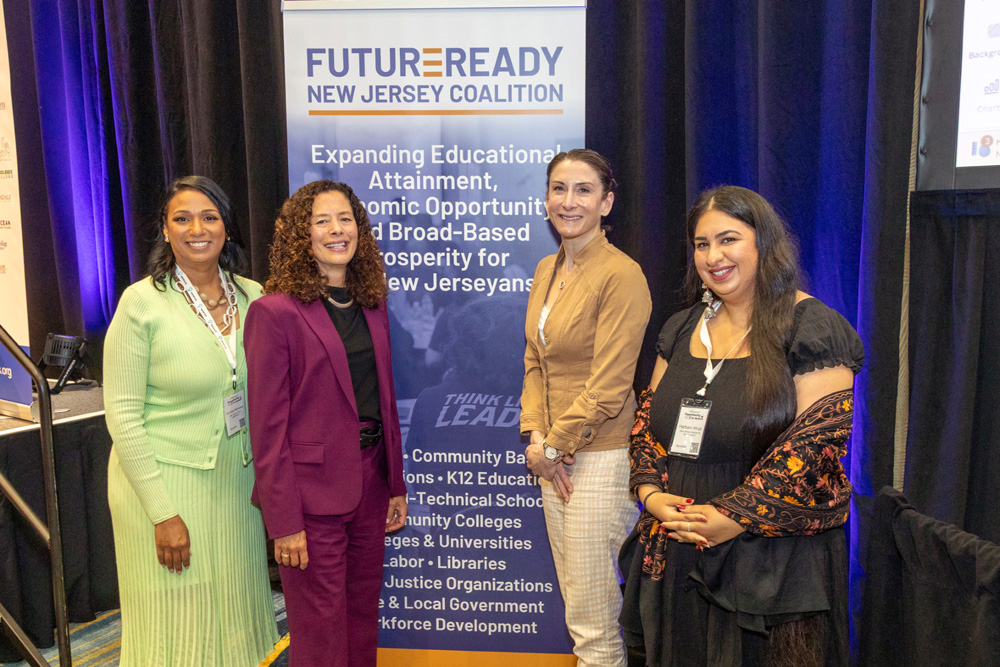
New Jersey Assembly Higher Education Chair Carmen Morales; Maria Heidkamp, Chief Innovation and Policy Officer, NJ Council of County Colleges; President and Chief Executive Officer of the HealthCare Institute of New Jersey, Chrissy Buteas; and New Jersey Institute for Social Justice Senior Counsel Harbani Ahuja
Photo credit: Joseph Sharp, All is Sharp Photography
Honoring a Legacy of Leadership
The Council honored the legacy of Dr. Steven M. Rose during its annual awards dinner, held in conjunction with the Summit. As part of the tribute to his remarkable career and an unwavering belief in the transformative power of higher education, the Council renamed its Visionary Leadership Award the President Steven M. Rose Visionary Leadership Award, ensuring that his example and values will continue to shape and inspire future generations of community college leaders.
“President Rose believed deeply that higher education changes lives and that New Jersey’s community colleges are strongest when they work together,” shares Fichtner. “Renaming the Council’s Visionary Leadership Award ensures that future generations of leaders will continue to be inspired by his vision, humility, generosity, and unwavering commitment to students.” Beginning in 2027, the President Steven M. Rose Visionary Leadership Award will be presented annually to a leader whose vision, service, and commitment have made a lasting and transformative impact on New Jersey’s community colleges.
“Thankfully, community colleges are well positioned not only to provide an affordable, high-quality postsecondary option, but also to help adults who are working to improve their prospects and adapt to a changing economy by earning new credentials, whether for credit or not for credit. I believe we’ve laid a strong foundation through the Opportunity Agenda and the Future Ready New Jersey Coalition, with a vision around expanding upward economic mobility and broad-based prosperity for New Jersey. That vision will remain at the forefront of our work because we believe it has the power to advance opportunity and prosperity across New Jersey.”
– Maria Heidkamp
Chief Innovation adn Policy Officer
NJCCC

Strengthening the Pipeline from High School
Achieving the 2040 goal will require more than increasing enrollment. According to Scherr, it calls for coordinated strategies that strengthen educational pathways, support today's learners, and ensure programs remain aligned with workforce needs. "The 75 by 2040 goal has become our north star. It provides a shared direction for the work we're doing, and it's been incredibly rewarding to see partners from across the state recognize how their missions align and come together to help achieve this important goal.
“We're strengthening the pipeline from high school through more intentional dual enrollment, helping students understand how those credits apply toward a degree, while also expanding support for adult learners who have some college but no credential, or who are just beginning their postsecondary education. Serving more adult learners has challenged us to rethink policies, practices, scheduling, instruction, and even pedagogy. At the same time, we're modernizing general education to better connect classroom learning with workforce skills while continuing to prepare students for successful transfer. That's how we move this goal from a vision to a reality."
As workforce needs continue to change, New Jersey's community colleges are building on years of student success initiatives while expanding their focus to ensure learners complete credentials that lead to meaningful career opportunities. "Over the past decade, we've learned a great deal through the Guided Pathways movement about helping students navigate college more intentionally,” shares Scherr. “Today, we're building on those lessons by focusing not just on student success, but on helping students earn credentials of value that support long-term economic mobility. Community colleges began with a mission of access. Then the focus became student success. Now we're asking an even bigger question: How do we ensure students leave with the knowledge, skills, and credentials that lead to family-sustaining careers and long-term success? I’m proud of how our colleges continue to learn from one another. This isn't a competition. When one institution finds a better way to serve students, they share it so everyone can benefit."
Creating an AI-Ready Workforce
This summer, NJCCC and the New Jersey AI Hub launched a statewide partnership, AI Ready NJ, to help New Jersey’s community colleges prepare students, faculty, and employers for a labor market increasingly shaped by artificial intelligence. The initiative aims to advance AI education and workforce readiness by equipping faculty with the knowledge and resources to incorporate AI into the classroom, strengthen colleges' ability to deliver AI-focused programs, and create more hands-on learning experiences that prepare students to apply AI skills in real-world workplace settings. "We know AI will continue to evolve, so it's not about preparing students for one specific tool. It's about giving them a strong foundation, helping them understand responsible and ethical use, and building the adaptability they'll need as the technology changes,” shares Scherr. “The partnership also allows us to expand work-based learning through paid AI micro-internships. Those experiences give students the opportunity to apply what they're learning to real projects, gain valuable workplace experience, and graduate with practical skills that will help them stand out as they enter the workforce."
Fichtner adds that the partnership gives NJCCC the opportunity to launch initiatives they’ve wanted to pursue for some time. “We also want to bring innovative faculty together from every discipline to share how they're integrating AI into writing, chemistry, engineering, sociology, and many other fields. Our goal is for every graduate to develop AI literacy through authentic learning experiences that are relevant to their area of study. AI literacy isn't one skill or one course. We want students to graduate with a strong foundation, an understanding of responsible and ethical AI use, and the ability to adapt as the technology continues to evolve. That preparation will look different across disciplines, but every student should leave college better equipped to succeed in a world where AI is becoming part of nearly every profession.
"We also recognize that community colleges have an important role beyond traditional students. As AI continues to reshape the workforce, colleges can serve as trusted places where workers and community members come to upskill, reskill, and build AI knowledge throughout their careers. Combined with expanded work-based learning opportunities like paid AI micro-internships and our close partnerships with local employers, we're helping ensure AI education reflects both workforce needs and the realities of the communities we serve."
Building Beyond the Budget Cycle
Sustaining long-term innovation in higher education requires a commitment that extends beyond any single funding cycle. For New Jersey's community colleges, the Opportunity Agenda provides a shared vision that helps institutions stay focused on transformation even as external factors continue to change. "We know budgets will ebb and flow, and there's only so much influence we have over those cycles,” says Fichtner. “What we can control is the work we're doing together—the vision we've created across 18 institutions and the commitment to meeting the changing needs of our students, communities, and economy. State and county investments in community colleges come with a responsibility to ensure those investments create meaningful impact. The more we innovate, respond to student and workforce needs, and demonstrate our value to communities, the stronger that case becomes. The Opportunity Agenda is our commitment to continuing that work and building the future we believe community colleges need to create together.”
Heidkamp adds, “There are other states that invest much more heavily in community colleges and use their systems more intentionally as part of the higher education and economic development landscape. We’re optimistic that the new administration will view partnerships with community colleges and the Council as integral to advancing priorities such as apprenticeships, work-based learning, industry-valued credentials, and helping New Jerseyans earn degrees and other credentials. We understand the fiscal reality the State is facing, and it is a precarious time for higher education institutions in many ways.
“Thankfully, community colleges are well positioned not only to provide an affordable, high-quality postsecondary option, but also to help adults who are working to improve their prospects and adapt to a changing economy by earning new credentials, whether for credit or not for credit. I believe we’ve laid a strong foundation through the Opportunity Agenda and the Future Ready New Jersey Coalition, with a vision around expanding upward economic mobility and broad-based prosperity for New Jersey. That vision will remain at the forefront of our work because we believe it has the power to advance opportunity and prosperity across New Jersey.”
As the Council works to strengthen its communications, it is drawing on new data to tell a fuller story about the economic and social value of New Jersey’s community colleges and their impact across the State. “From a recent economic impact study conducted, we are armed with new insights into our $12.8 billion impact on the State’s economy and the 135,000 jobs we contribute to and support, as well as an $8 return to society for every dollar invested,” shares Heidkamp. “That includes, on average, an additional $10,000 a year that someone with an associate degree earns compared to someone with a high school diploma. There are many benefits of postsecondary education that can get lost when the headline is simply that people are turning away from college. We need to tell the fuller story; one that recognizes not only the economic value of a college education, but the broader ways it strengthens individuals, communities, and New Jersey’s future.”
Uniting Student Leaders
On April 24, 2026, NJCCC welcomed more than 260 community college student leaders to Brookdale Community College (BCC) for the 2026 Student Leadership Summit. With the theme, Connect. Collaborate. Lead., the event united student leaders from academics, athletics, the arts, student government, and community service to create opportunities for collaboration, strengthen leadership skills, and build connections across disciplines. "Seeing 260 incredible student leaders from very different backgrounds come together to network, learn from one another, and feel part of a broader community was extremely exciting,” shares Fichtner. “Since leadership can take many different forms, we were intentional about bringing together leaders from across campus life. At a time when there is so much uncertainty, creating opportunities for students to connect, share experiences, and recognize that they are valued members of a larger community was incredibly impactful."
At this year’s Summit, two students were recognized with the New Jersey Student of the Year Award to celebrate their academic excellence, character, inspirational success, and/or service to their communities. Alexandra Montoya of Atlantic Cape Community College exemplifies the determination, leadership, and service of New Jersey’s community college students. A two-time NJCAA All-Academic Team member and Liberal Arts K–12 major at Atlantic Cape, she has excelled academically while competing in both volleyball and basketball. Beyond campus, Alexandra gives back through her work with the Boys & Girls Club and as an assistant volleyball coach, where she mentors and supports young athletes.
Also honored at the Summit was Dalia Cancel Batista. From beginning her college career at sixteen years old to earning three STEM degrees simultaneously, Dalia has demonstrated extraordinary academic drive and determination. She is graduating from Mercer County Community College with degrees in Engineering, Physics, and Mathematics while completing more than 600 hours as a medical intern and conducting original research. A campus leader and mentor, Dalia has held multiple student organization leadership roles, served as a STEM tutor, and worked to encourage younger students to pursue STEM.